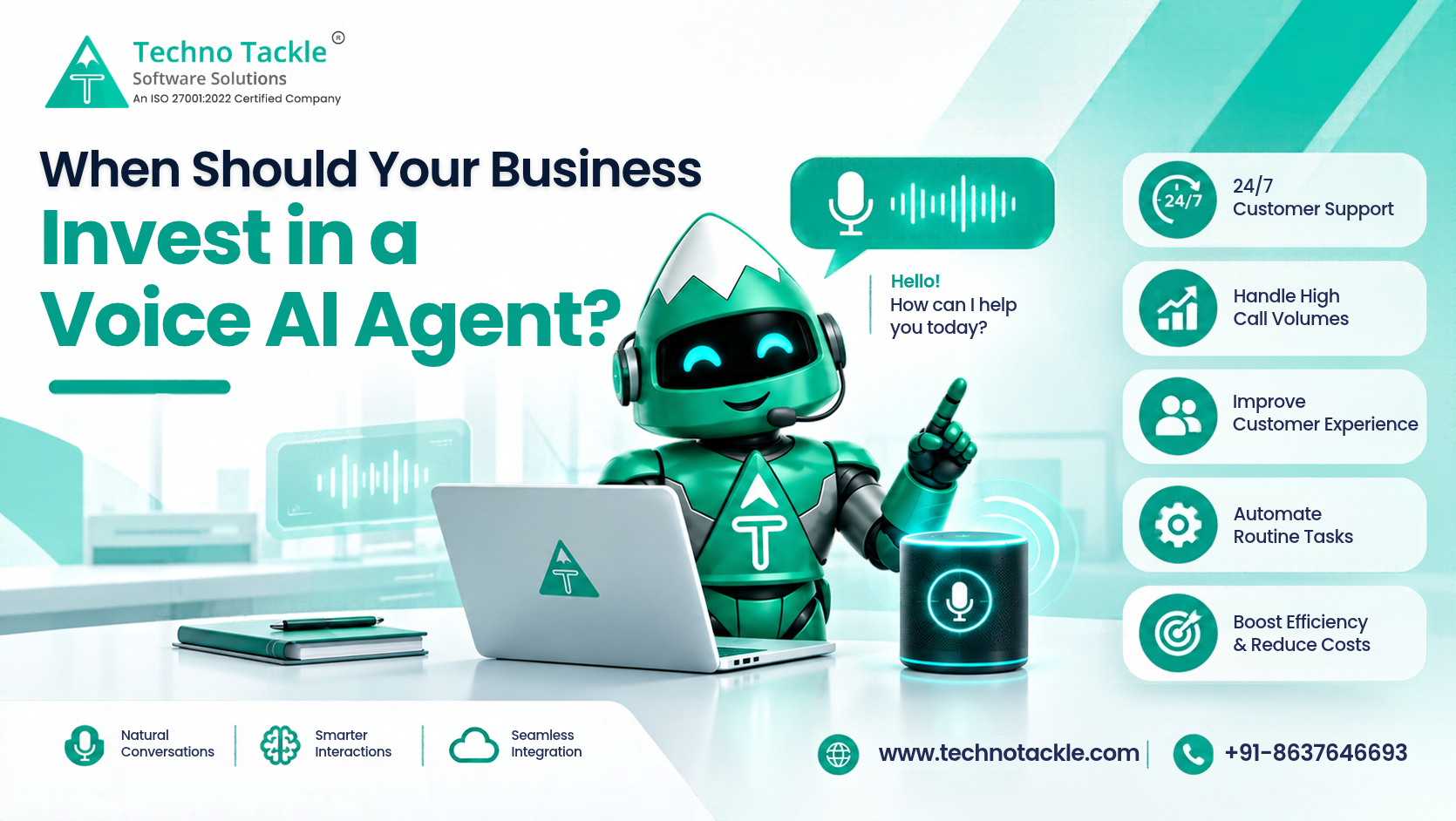
Voice AI is moving fast, and every vendor says now is the time. But a voice agent that launches too early, on the wrong calls, can annoy customers and waste budget.
Here is the short answer. Invest in an AI voice agent when you have a high volume of repetitive calls, clear answers to most of them, and a real cost from missed or slow calls. Wait if your calls are rare, highly emotional, or your processes are still unclear.
This guide helps you decide, step by step, and shows how to start without taking big risks.
What an AI Voice Agent Actually Is
An AI voice agent is software that talks to people on a call. It listens, understands what was said, decides what to do, and replies in a natural voice. Good ones can also take action, such as booking an appointment or updating an order.
A typical voice agent combines five parts:
-
Speech-to-text to turn the caller's words into text
-
A language model to understand intent and plan the reply
-
Text-to-speech to answer in a natural voice
-
Memory to keep context during the call
-
Integrations to read and write in your CRM, calendar, or ticketing tools
It is not the same as an old phone menu. A menu says "press 1 for sales." A voice agent lets the caller speak normally and handles the task. Our comparison of voice AI agents vs chatbots vs IVR explains the differences in detail.
Signs It Is the Right Time to Invest
You do not need all of these. Two or three strong signs are enough to justify a pilot.
1. You have many repeat calls
If a large share of your calls ask the same things, such as order status, opening hours, appointment changes, or simple FAQs, a voice agent can handle them at any hour. Repetition is what makes automation pay back.
2. You are missing calls
Missed calls are missed revenue. If calls go to voicemail after hours, at lunch, or during peaks, an agent can answer every one and pass urgent cases to a person.
3. Wait times are hurting you
Long hold times drive customers away. If your team is stretched and callers wait, an agent can take the simple calls so staff can focus on the hard ones.
4. Your team spends time on routine tasks
Staff who spend half their day confirming appointments, qualifying leads, or giving status updates are doing work a machine can do. Freeing them for higher-value work is a clear gain.
5. You need multiple languages
If callers speak different languages and hiring for each is hard, a multilingual voice agent can widen your reach. Test accuracy for each language and accent you plan to support, because quality varies.
6. Your processes are clear and documented
An agent can only follow rules you can write down. If you know what a good call looks like, which questions get which answers, and when to hand over to a person, you are ready.
7. Your systems have usable data and APIs
To take action, the agent needs access to your tools. If your CRM, calendar, or ticketing system can be reached through standard connections, building is far easier.
Signs You Should Wait
A voice agent is not right for everyone yet. Hold off if:
-
Call volume is low, so the saving would be small.
-
Most calls are emotional, sensitive, or need deep judgement, such as complaints with high stakes.
-
Your answers change often and nobody owns the knowledge base.
-
Your processes are unclear, so even your staff give different answers.
-
You cannot connect to your core systems.
-
You expect it to replace your whole team on day one.
In these cases, fix the basics first. A voice agent will expose weak processes faster, not hide them.
Good First Use Cases
Start with calls that are frequent, simple, and low risk.
-
FAQs and status checks. Hours, locations, delivery or order updates.
-
Appointment booking and reminders. Schedule, confirm, reschedule, and cancel.
-
Lead qualification. Ask a few set questions and route promising leads to sales.
-
After-hours answering. Capture the request and pass it on in the morning.
-
Outbound reminders. Payment due, renewal, or follow-up calls.
-
Internal assistants. Staff ask for data by voice instead of searching a screen.
Avoid starting with your hardest calls. Prove the idea on easy ones, then widen the scope.
Platform or Custom Build?
When you invest in an AI voice agent, you have two main routes.
Use an AI voice agent platform. Ready-made platforms let you configure agents quickly, often with a no-code builder. They suit common use cases, small teams, and fast tests. The trade-offs are less control, limits on how deep integrations go, and fees that grow with usage.
Build a custom voice agent. A custom build is designed around your calls, your systems, and your rules. It suits complex flows, strict privacy needs, unusual integrations, or high volumes where per-minute fees add up. It takes longer and costs more at the start.
Many businesses start on a platform to learn, then build custom for the calls that matter most. If you are weighing the two routes, a team that offers voice AI agent development can help you scope what fits.
When you compare any AI voice agent platform, check:
-
How natural and fast the voice feels. Delays break the flow of a call.
-
How well it handles interruptions, accents, and background noise.
-
Which languages it supports, and how well.
-
How it connects to your phone system, CRM, and calendar.
-
How it hands a call to a human, with context.
-
What it records, where data is stored, and who can access it.
-
How pricing works: per minute, per call, per seat, or flat.
For a closer look at costs and build time, see our guide on custom voice AI agent development: cost and timeline.
What Drives the Cost
No honest vendor can quote a number without knowing your use case. These factors move the price:
-
Number and complexity of call flows
-
Inbound, outbound, or both
-
Languages and accents
-
Depth of integrations
-
Call volume and peak load
-
Voice quality and speed needs
-
Security and hosting needs
-
Testing, monitoring, and upkeep
Plan for ongoing cost, not only the build. Voice agents need tuning as products, prices, and policies change.
To judge value, compare the cost against what you spend today on missed calls, staff time, and overtime. Our post on the ROI of AI voice agents in customer support shows how to frame it.
How to Run a Safe Pilot
Do not launch to all customers on day one. Use stages.
-
Pick one use case. One call type, one language, one outcome.
-
Write the conversation rules. What the agent may say, what it must not do, and when it hands over.
-
Build and test with simulated calls. Include accents, interruptions, and awkward questions.
-
Soft launch. Route a small share of real calls to the agent.
-
Review calls weekly. Listen to recordings, find failures, and fix them.
-
Expand only when results hold.
Always give callers an easy way to reach a human. Trust drops fast when a caller feels trapped.
Quality matters most here. Our page on testing AI agents explains how to check answers before and after launch.
Measure What Matters
Set targets before launch, so you can judge the result honestly.
-
Share of calls fully handled without a person
-
Average handling time
-
Caller satisfaction
-
Missed or abandoned calls
-
Handover rate and reasons
-
Cost per call compared with before
-
Errors found in call reviews
Be careful with promised numbers. No system handles every call correctly, so any vendor quoting a fixed success rate before seeing your calls is guessing.
Risks to Plan For
-
Wrong or invented answers. Ground the agent in approved information, and test it.
-
Privacy and consent. Tell callers they are speaking to an AI, follow call-recording rules in your region, and limit who can see recordings.
-
Poor handover. Pass the caller and the context to a person smoothly.
-
Brand voice. Choose a voice and tone that fits how your team speaks.
-
Over-trust. Keep humans in the loop for decisions with legal or financial weight.
Bottom Line
Invest in an AI voice agent when you have many repeat calls, a real cost from missed or slow calls, clear processes, and systems it can connect to. Start with one simple use case, run a controlled pilot, measure the results, and expand from evidence.
If the signs are not there yet, improve your processes and data first. The agent will be easier to build, and better, when you are ready.
Frequently Asked Questions
What is an AI voice agent?
It is software that holds spoken conversations, understands what the caller wants, and can take action in your systems, such as booking an appointment or checking an order.
How is an AI voice agent different from IVR?
IVR follows fixed menus and keypad choices. A voice agent understands natural speech and can handle tasks, so callers do not need to navigate menus.
What is an AI voice agent platform?
It is a ready-made product for building and running voice agents, often with a visual builder, phone connections, and analytics. It is faster to start with, while a custom build offers more control.
Can an AI voice agent make outbound calls?
Yes. Common uses include reminders, confirmations, follow-ups, and lead qualification. Check consent and calling rules in your region first.
Does an AI voice agent support multiple languages?
Many do, but quality varies by language and accent. Test each language you need with real callers before launch.
Will it replace my support team?
Usually not. It handles simple, repeated calls so your team can focus on complex ones. Always keep a path to a human.
How long does it take to launch?
It depends on scope, integrations, and testing. A focused pilot can be much quicker than a full rollout. Ask for a phased plan with a first release date.
Not sure if your calls are ready for automation? That is a short conversation, not a long project.
Book a free 15-minute consultation with our team
Related reading: