November 16, 2026
Most businesses already automate something. A rule sends an invoice reminder. A script copies data between two systems. A workflow routes a form to the right person.
Now AI promises to automate more. But AI is not always the better choice. Using it where a simple rule would do adds cost, risk, and complexity for no gain.
Here is the short answer. Choose traditional automation when the task is predictable, the inputs are structured, and the rules rarely change. Choose AI automation for business when the inputs are messy, the decisions need judgement, or the rules are too many to write by hand. Often the best answer is both, working together.
This guide shows how to tell which one fits each task.
What Traditional Automation Does Well
Traditional automation follows fixed rules. If this happens, do that. It includes scripts, scheduled jobs, workflow tools, and robotic process automation.
It works best when:
-
Inputs are structured. Form fields, database records, and fixed file formats.
-
Steps are the same every time. Copy, check, send, update.
-
Rules are clear and stable. "If the invoice is over this amount, send for approval."
-
Errors must be near zero. The same input always gives the same output.
-
You need to explain every result. You can trace exactly why it did what it did.
It is also cheap to run and easy to audit. For a stable, repeated process, it is often the right tool, and there is no reason to replace it.
Its weakness is change. When an input looks slightly different, or a new case appears, a rule-based system stops or gives a wrong result until someone updates the rules.
What AI Automation Adds
AI automation uses models that can read language, understand context, and make a reasonable decision when there is no exact rule. A modern AI system can read an email, work out what the customer wants, look up the right record, and take the next step.
AI automation software typically combines:
-
A language model to understand text, speech, or documents
-
Tools and connections to read and write in your systems
-
Memory to keep context across steps
-
Guardrails to limit what it can do and check what it produces
-
Monitoring to track quality and cost
The strength of AI is handling variety. It copes with messy input, new cases, and unclear requests. Its weakness is that it can be wrong, and it can be wrong in a confident way. That is why testing and controls matter.
Some AI systems act as agents. They plan a task in steps, use tools, and check their own work. Our page on custom AI agent development describes how these are built around your systems.
Signs You Should Choose AI Automation
Consider AI automation for business when several of these are true.
1. The input is unstructured
Emails, chat messages, PDFs, call transcripts, and free-text forms do not fit neat fields. Rules struggle here. AI reads them the way a person would.
2. The task needs judgement
Sorting support tickets by urgency, spotting a risky contract clause, or deciding which lead to call first all need a view, not a formula.
3. There are too many rules to write
When a process has hundreds of exceptions, writing and maintaining rules becomes its own job. A model can learn the pattern from examples and instructions.
4. The process changes often
If products, policies, or forms change every few months, a rule-based flow needs constant edits. AI can adapt faster, as long as it has current information to draw on.
5. People spend hours reading and summarising
Reports, meeting notes, documents, and long email threads take time. AI can pull out the key points, draft a reply, or fill in a form for a person to check.
6. You need to answer from your own documents
If staff or customers ask questions that depend on your policies, manuals, or records, AI can search them and answer with sources. A well-built RAG solution does exactly this.
7. You want natural language as the interface
If users would rather ask in plain words than click through menus, AI can turn a request into actions across several systems.
Signs You Should Stay With Traditional Automation
Stick with rules when:
-
The process is the same every time and runs well.
-
The inputs are already clean and structured.
-
A wrong result would be costly, and you need exact, repeatable answers.
-
Regulations demand a fully traceable decision path.
-
The saving is small and the AI cost would eat it.
-
A simple script or workflow would take a day, not a project.
Do not use a language model to add two numbers or move a file on a schedule. It is slower, costs more, and can make mistakes a script never would.
The Best Answer Is Often Both
Most strong systems mix the two. Let each part do what it is good at.
-
Rules handle the fixed parts. Validation, calculations, approvals, and scheduling.
-
AI handles the messy parts. Reading the email, extracting the data, deciding the category, drafting the reply.
-
A person reviews the risky parts. Large payments, legal text, and unusual cases.
For example, an AI step can read an incoming invoice in any format and pull out the fields. A rule then checks them against the purchase order and routes the result for approval. Each tool does the job it suits.
Our post on AI for lead generation and lead qualification automation shows this mix in a sales setting.
Simple Comparison by Factor
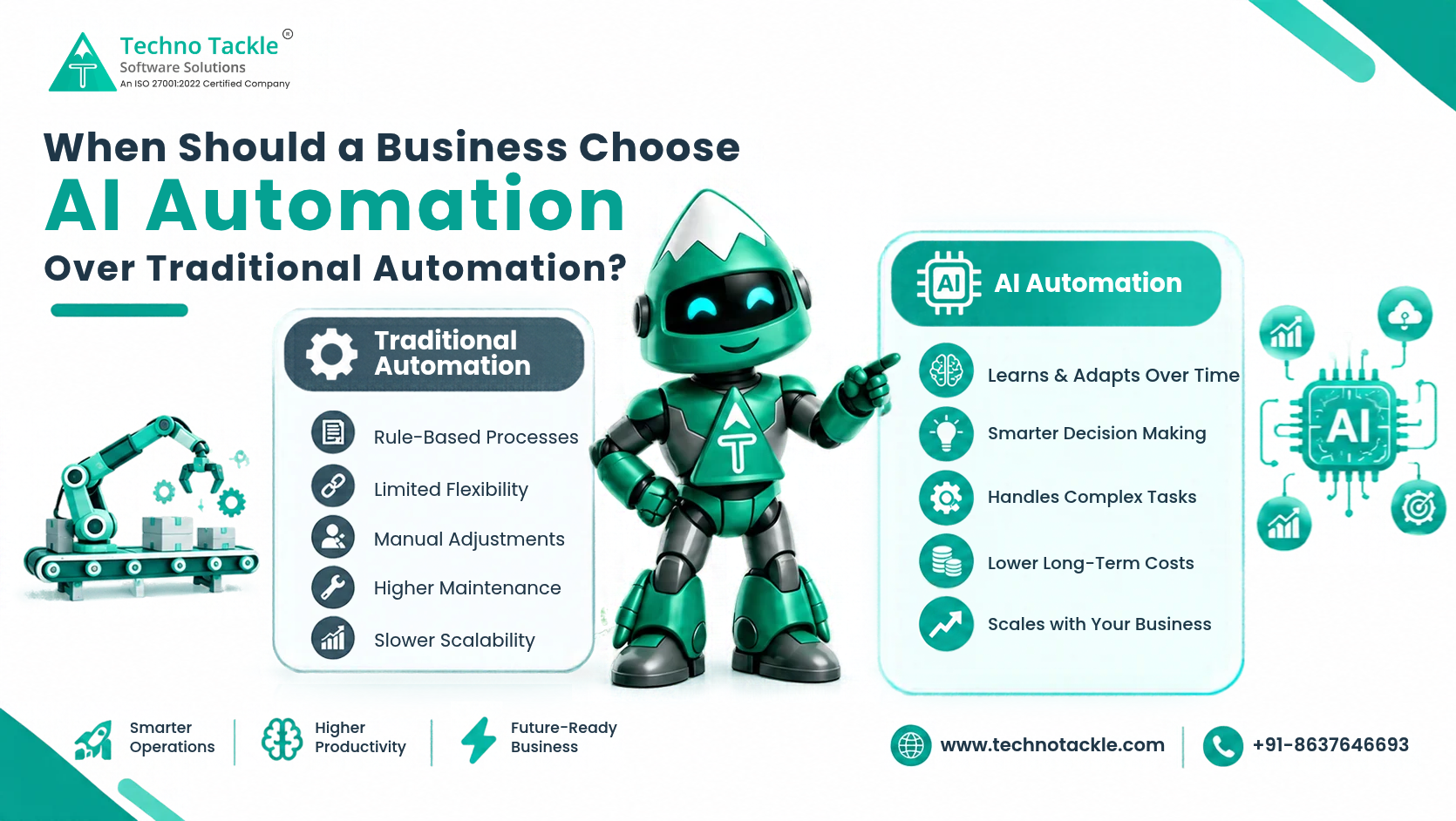
Input type: Traditional automation needs structured data. AI handles structured and unstructured data.
Decisions: Traditional automation follows set rules. AI makes judgement-based decisions.
Change: Traditional automation needs manual rule updates. AI adapts with new instructions and data.
Predictability: Traditional automation gives the same output for the same input. AI output can vary and needs checks.
Cost to start: Traditional automation is usually lower for simple tasks. AI costs more to set up and run, especially at high volume.
Explainability: Traditional automation is easy to trace. AI needs logging and review to explain its steps.
A Simple Decision Checklist
For each task, answer yes or no.
-
Is the input mostly unstructured text, speech, or documents?
-
Does the task need judgement, not only rules?
-
Would the rules be too many or too hard to maintain?
-
Does the process change often?
-
Is a small error rate acceptable, with a human check for risky cases?
-
Is the volume large enough to justify the cost?
0 to 1 yes: use traditional automation. 2 to 3 yes: consider a hybrid, with AI for the messy step and rules for the rest. 4 or more yes: AI automation is likely the better fit.
Risks to Plan For
-
Wrong answers. Ground the AI in approved data, show sources, and test against real cases.
-
Data privacy. Know what data goes to which model, and who can see logs.
-
Cost creep. Usage fees grow with volume. Track cost per task from day one.
-
Over-automation. Keep humans in the loop for decisions with legal or financial weight.
-
No upkeep. AI systems need tuning as documents, prompts, and models change.
Testing matters more with AI than with rules. Our page on testing AI agents explains how to check behaviour before and after launch.
How to Start
Do not try to automate everything. Use a staged plan.
-
List your repeated tasks. Note volume, time spent, and error cost.
-
Score each task with the checklist above.
-
Pick one high-value, low-risk task. Something frequent where a mistake is easy to catch.
-
Run a pilot on a small share of real work, with a person reviewing results.
-
Measure. Time saved, error rate, cost per task, and user feedback.
-
Expand only if the numbers hold.
If you are unsure which tasks suit AI, a short Gen AI consulting engagement can rank your use cases by value and risk before you spend on a build.
To judge return, our post on how to calculate ROI on technology projects gives a simple method.
Bottom Line
Use traditional automation for stable, structured, rule-based work. Use AI automation for business when inputs are messy, decisions need judgement, or the rules are too many to maintain. Combine them where it makes sense, keep a human in the loop for risky steps, and prove value with a small pilot before you scale.
If you are comparing AI automation software or planning a custom build, start with one clear task and measure the result. Our AI automation services team can help you scope a first release.
Frequently Asked Questions
What is AI automation for business?
It is the use of AI models to carry out tasks that need understanding, judgement, or language, such as reading documents, answering questions, sorting requests, or completing steps across your systems.
How is AI automation different from traditional automation?
Traditional automation follows fixed rules on structured data. AI automation can handle messy input and decisions that rules cannot cover, but its output needs testing and review.
What is AI automation software?
It is software that uses AI models to automate tasks. It can be a ready-made product or a custom system built around your data, tools, and rules.
Will AI automation replace traditional automation?
No. Rules are still the best tool for stable, structured tasks. Many strong systems use both.
Is AI automation more expensive?
It usually costs more to build and run, especially at high volume. It pays off where it saves significant time or handles work rules cannot. Compare total cost, not only the first invoice.
Is AI automation safe for sensitive data?
It can be, when designed for it. Options include access control, encryption, audit logs, and private deployment. Check where data goes and who can see it before you start.
How long does it take to launch?
It depends on scope, data readiness, and integrations. A focused pilot is much quicker than a full rollout. Ask for a phased plan with a first release date.
Not sure which of your tasks suit AI? That is a short conversation, not a long project.
Book a free 15-minute consultation with our team
Related reading: