AI Development Build AI voice agent system showing speech recognition, LLM processing, and text-to-speech workflow for business automation

April 22, 2026

Build AI Voice Agent for Your Business: Use Cases, Benefits & How It Works

Your phone rings. No one answers. The customer calls a competitor.

That is the reality for thousands of businesses still relying on human agents or outdated IVR menus. Customers today expect instant, accurate responses around the clock. They will not wait. They will not press 1 for sales and 2 for support. They will simply leave.

The solution is to build AI voice agent systems that handle real conversations, qualify leads, and resolve queries automatically. No hold music. No missed calls. No wasted budget on repetitive phone tasks.

In this guide, we break down what voice AI agents are, how they work, where they deliver the most value, and how Techno Tackle helps businesses go from zero to a live AI voice agent without the usual complexity.


What Is a Voice AI Agent?

A voice AI agent is a software system that understands spoken language, determines caller intent, and responds in natural human-like speech. It handles entire conversations automatically without a human on the other end.

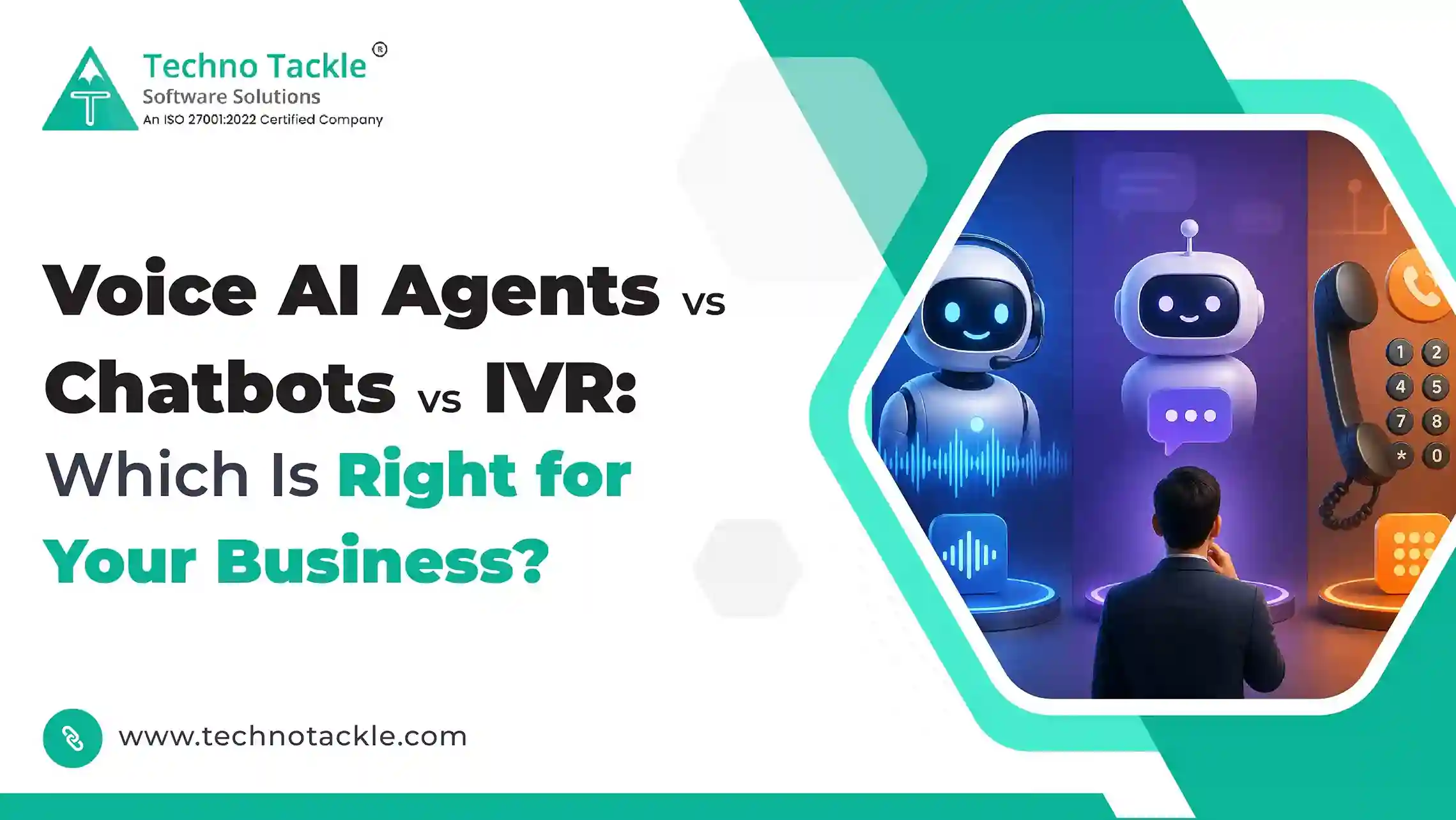
Unlike old IVR systems that route calls through rigid menus, voice AI agents understand context. A caller can say 'I want to reschedule my appointment for next Tuesday' and the agent handles it from start to finish. No button presses required.

Modern voice AI agents are powered by three technologies working together: Automatic Speech Recognition (ASR) converts voice to text, Large Language Models (LLMs) understand meaning and generate responses, and Text-to-Speech (TTS) converts responses back to natural speech. The result is a system that sounds and behaves like a trained human agent, at scale, 24/7. This is the foundation of serious voice AI agent development today.


The Real Cost of Not Automating Your Voice Channel

Here is what businesses lose every day without a voice AI agent in place:

  • Missed calls outside business hours mean lost leads who never call back.
  • Hold queues frustrate callers. Research shows 60% of callers hang up after 90 seconds on hold.
  • Repetitive tier-1 queries consume agent time that should go toward complex, high-value work.
  • Inconsistent responses damage brand trust and inflate complaint resolution times.
  • Scaling human call centers to match growth is expensive. Hiring, training, and managing agents does not scale cleanly.


The voice channel is not declining. It is becoming more critical. The global voice and speech recognition market is projected to grow from $14.8 billion in 2024 to over $61 billion by 2033. The businesses building voice AI now will hold a structural advantage that is difficult to close later.


How Does a Voice AI Agent Work?

Every voice AI agent follows a three-stage process. Understanding this helps you make better decisions when you build AI voice agent systems for your business.

Diagram explaining how a voice AI agent works, showing steps such as speech input, speech-to-text conversion, natural language understanding, decision processing, text-to-speech response, and real-time voice interaction.

Stage 1: Speech-to-Text (ASR)

The moment a caller speaks, an Automatic Speech Recognition engine converts that audio into text in near real-time. Modern ASR systems handle different accents, background noise, and domain-specific vocabulary at high accuracy. Top systems achieve word error rates below 5%.


Stage 2: Language Understanding (LLM)

The transcribed text is processed by a Large Language Model. The LLM identifies caller intent, maintains conversation context across multiple turns, and determines the right action. It can pull information from CRMs, databases, and business systems in real time. This is where the intelligence lives.


Stage 3: Text-to-Speech (TTS)

The agent's response is converted back to natural, human-like speech and played to the caller. Advanced TTS systems adjust tone based on context. A billing query gets a calm, professional tone. A lead qualification call can be warmer and more conversational.


This full cycle happens in under two seconds. The conversation feels natural because the latency is low and the response quality is high. That is the benchmark every serious AI voice agent development project should hit.


AI Voice Agent vs. Traditional IVR: A Clear Comparison


 Capability

 Traditional IVR

 AI Voice Agent

 Input method

 Button presses, single keywords

 Natural conversational speech

 Conversation flow

 Fixed linear menus

 Dynamic, context-aware dialogue

 Task complexity

 Basic routing only

 Multi-step tasks, CRM updates,   bookings

 Personalization

 Generic, impersonal

 Uses caller history and CRM data

 Learning

 Static, manual updates

 Improves from real conversation   data

 Availability

 24/7 but limited utility

 24/7 with full resolution capability


The gap is significant. IVR routes calls. AI resolves them. When you build AI voice agent systems to replace IVR, the operational and customer experience improvement is immediate.


Top Use Cases for Voice AI Agents

Voice AI agent development delivers measurable results across specific business functions. Here are the highest-impact use cases:

Infographic outlining top use cases for voice AI agents, including customer support automation, appointment scheduling, lead qualification, order processing, and real-time customer interactions across industries.

1. Customer Support Automation

Handle tier-1 support calls without wait times. Voice AI agents answer FAQs, process returns, troubleshoot common issues, and escalate complex cases to the right human agent with full context. In documented cases, AI agents manage up to 77% of L1-L2 support volume. For any business with significant inbound call volume, this is where the ROI from ai voice agent development is fastest.


2. Lead Qualification and Sales

AI voice agents run outbound qualification calls at scale. They ask the right questions, score leads based on responses, and route hot prospects directly to sales reps. This removes the manual dialing burden from your team and ensures sales reps spend time only on qualified conversations.


3. Appointment Scheduling and Reminders

Healthcare clinics, real estate agencies, and service businesses use voice AI agents to schedule, reschedule, and confirm appointments automatically. The agent syncs with your calendar in real time, sends confirmation details, and sends reminder calls before appointments. No manual coordination required.


4. Banking and Financial Services

Balance inquiries, transaction checks, loan application steps, and fraud alert all work through voice AI. The agent authenticates the caller, accesses account data, and provides accurate responses in seconds. Compliance-ready with HIPAA and SOC 2 standards available.


5. Real Estate and E-Commerce

Real estate teams use voice AI agents to qualify buyer and seller leads, schedule property visits, and answer listing questions at scale. E-commerce businesses automate order tracking, return processing, and product queries. Both use cases let small teams compete with enterprise-level responsiveness.


Key Benefits of Building an AI Voice Agent

The decision to build AI voice agent systems is a business case decision, not a technology curiosity. Here are the numbers that matter:


  • 24/7 availability without adding headcount. Your voice channel never closes.
  • 30% to 200% ROI improvement in the first year for businesses implementing automation, according to industry reports.
  • Up to 30% reduction in operational expenses through hyper automation of repetitive call tasks.
  • Instant scalability. Handle thousands of concurrent calls without performance drops.
  • Consistent accuracy. Every caller gets the same quality response, every time.
  • CRM integration means every interaction logs automatically. No data entry, no dropped context.


The customer satisfaction impact is also measurable. Automating call workflows improves customer satisfaction scores by approximately 7%, and businesses that handle calls faster see a direct impact on retention and repeat purchase rates.


How to Build an AI Voice Agent: A Practical Overview

If you want to build AI voice agent systems for your business, the process has six clear steps. Techno Tackle handles every stage of this for clients, from definition through deployment and ongoing optimization.


Step 1: Define the use case

Pick one specific problem to solve first. High call volume from support? Missed leads after hours? Appointment no-shows? Starting narrow delivers faster ROI and cleaner data for optimization.


Step 2: Map conversation flows

Design the primary dialogue path, then the edge cases. What does the caller say? What information does the agent need to collect? What happens when the agent does not understand? How does escalation to a human work? This design work determines how useful the agent actually is.


Step 3: Choose the right infrastructure

Select ASR, LLM, and TTS components that match your latency and accuracy requirements. The difference between 85% and 95% ASR accuracy cuts error rates from 15 per 100 words to 5. That gap matters in real conversations. Techno Tackle evaluates and selects the right stack for your specific use case, not a generic default.


Step 4: Integrate with your business systems

Connect the agent to your CRM, booking platform, product database, or EHR system. This is the most technically demanding step and where most in-house attempts stall. Proper integration is what separates a demo from a production-grade system.


Step 5: Test with real users

Run pilot testing with internal teams first, then a controlled customer segment. Track where conversations break down. Refine dialogue flows and edge case handling before full rollout.


Step 6: Monitor and optimize

Track completion rate, escalation rate, average handling time, and customer satisfaction. Voice AI agent development is not a one-time project. The agent improves as real conversation data accumulates.


Ready to map out your first voice AI use case? Book a free strategy call with Techno Tackle.


Common Challenges in AI Voice Agent Development (and How Techno Tackle Solves Them)

Most businesses hit the same obstacles when they try to build AI voice agent systems internally. Here is what those look like and how Techno Tackle addresses each one:


Challenge 1: High Latency Making Conversations Feel Unnatural

Conversations feel awkward when there are 3-second pauses between the caller speaking and the agent responding. This is a common problem with poorly optimized pipelines. Techno Tackle uses streaming transcription and optimized LLM inference to keep response latency under 1.5 seconds in most production deployments. The conversation feels real because the timing is right.


Challenge 2: Poor Accuracy on Industry-Specific Vocabulary

Generic ASR models struggle with medical terms, financial jargon, or product names. Techno Tackle customizes acoustic models and adds domain-specific vocabulary lists as part of every ai voice agent development engagement. Accuracy on your specific content improves significantly compared to out-of-the-box models.


Challenge 3: Integration Complexity with Legacy Systems

Connecting a voice AI agent to older CRM systems, custom databases, or legacy telephony platforms is where most projects get stuck. Techno Tackle's engineering team has built integrations with Salesforce, HubSpot, custom ERPs, and hospital management systems. We handle the API layer, so your team does not have to.


Challenge 4: Compliance and Data Privacy

Voice interactions contain sensitive data. For healthcare clients, HIPAA compliance is non-negotiable. For US-based outbound calling, TCPA consent requirements apply. For European clients, GDPR governs data handling. Techno Tackle builds compliance into the architecture from day one, not as an afterthought. Learn more about our approach. Click here.


Challenge 5: The Agent Does Not Improve Over Time

Many voice ai agent development projects go live and then stagnate. The agent handles the same errors six months later because no one built a feedback loop. Techno Tackle includes conversation analytics and a quarterly optimization review in every engagement. Your agent gets measurably better over time, not just functional at launch.


Why Choose Techno Tackle for Voice AI Agent Development

Techno Tackle is a specialist AI development firm focused on building production-grade voice AI systems for businesses that need real results, not experiments.


  • End-to-end delivery: Strategy, design, development, integration, testing, deployment, and optimization.
  • Industry-specific expertise: Healthcare, financial services, real estate, e-commerce, and contact centers.
  • No vendor lock-in: We select the best ASR, LLM, and TTS components for your use case, not a single bundled platform.
  • Fast time-to-live: Most clients go from brief to live pilot in 6 to 8 weeks.
  • Compliance-ready builds: HIPAA, GDPR, TCPA, and SOC 2 standards built in where required.


Whether you want to build AI voice agent systems from scratch or improve a failing implementation, Techno Tackle brings the technical depth and delivery track record to get it done. Visit Techno Tackle to see our recent work.


Speak with our voice AI team this week. Book your free 30-minute consultation on Calendly.


The Future of AI Voice Agent Development

The technology is improving fast. Every few months brings lower latency, higher accuracy, and better multilingual support. End-to-end AI models that process audio directly without ASR-LLM-TTS handoffs are already in production at leading companies.

More importantly, the cost of ai voice agent development is dropping. Full-stack voice AI platforms now cost between $0.01 and $0.05 per minute of handled conversation. For a business handling 500 calls per day, the math is straightforward. Automation at scale costs a fraction of human call center operations.

Businesses that invest in voice AI agent development now will build proprietary conversation data, optimized models, and operational systems that competitors cannot replicate quickly. The window to build a durable advantage is open now.


Frequently Asked Questions


What does it cost to build an AI voice agent?

Full-stack voice AI platforms run $0.01 to $0.05 per minute of handled conversation. Custom development costs vary based on integration complexity, conversation design, and compliance requirements. Techno Tackle provides fixed-scope engagements with clear deliverables and pricing.


How long does voice AI agent development take?

For a defined single-use case with clean integrations, expect 6 to 8 weeks from brief to live pilot. More complex multi-use case builds with legacy system integrations typically run 10 to 14 weeks.


Do I need a large technical team to build AI voice agent systems?

No. When you work with Techno Tackle, you need a product owner who understands your use case and business rules. We handle all technical delivery. Your team reviews, tests, and approves.


Is AI voice agent development only for large enterprises?

No. Small and mid-size businesses often see faster ROI because the baseline inefficiency is higher. A 10-person sales team missing after-hours leads is a cleaner problem to solve than a Fortune 500 contact center with 200 edge cases.


How is a voice AI agent different from a chatbot?

A chatbot uses text. A voice AI agent uses spoken language. Voice adds ASR and TTS layers, increases latency complexity, and requires different conversation design. Voice also handles higher-urgency interactions because callers typically have problems they want resolved immediately.


What industries benefit most from voice AI agents?

Healthcare (scheduling, reminders, patient intake), financial services (account inquiries, fraud alerts, loan processing), real estate (lead qualification, showing scheduling), e-commerce (order tracking, returns), and any business with high inbound call volume and repetitive query patterns.


Conclusion

The decision to build AI voice agent systems is a direct response to a clear business problem: your voice channel cannot scale with human agents alone, and your customers will not wait.

Voice AI agent development is no longer experimental. It is production-ready, ROI-positive, and deployable in weeks. The businesses building now are not taking a risk. They are closing a gap.

Techno Tackle has the technical expertise and the delivery process to take you from use case definition to a live, optimized voice AI agent. The first step is a conversation.

Book your free consultation at Calendly and tell us what problem you need to solve.

Stop losing calls, leads, and customers to manual processes.

Schedule your free AI Voice Agent strategy session with Techno Tackle now.

Read more
Staff Augmentation IT staff augmentation concept with developer and virtual team interface (2026)

April 25, 2026

IT Staff Augmentation: What It Is, How It Works, and When to Use It (2026)

The Hiring Gap That's Slowing Your Business Down

You need a senior DevOps engineer. Your product launch is in six weeks. Your internal team is stretched thin. The usual hiring process takes three months minimum.

That gap costs you deadlines, revenue, and momentum. And it's not a rare situation , it's the everyday reality for most growing businesses today. Skill shortages are real. Permanent hiring is slow and expensive. Project timelines do not wait.

IT staff augmentation services exist to close that gap , fast, flexibly, and without the financial overhead of a full-time hire.


What Is IT Staff Augmentation?

IT staff augmentation is a staffing model where external IT professionals join your existing team on a temporary basis, working under your management, inside your workflows, using your tools. You direct the work. You own the output. The augmented professional integrates as a natural extension of your team.

This is the core difference from outsourcing: with IT augmentation services, control stays with you. The external professional does not manage their own workflow or report to a vendor. They report to you.

IT staff augmentation differs from permanent hiring in two key ways: there is no long-term salary commitment, and the right person can be onboarded in three to five business days , not three months.


How Does IT Staff Augmentation Work?

The process has five stages and how it works?

        You identify the gap , a skill your in-house team lacks, a resource shortage, or a project demand spike.

        You define the role , technologies required, seniority level, time commitment, and expected output.

        Your provider finds the match , a good IT staff augmentation partner like Techno Tackle sources, screens, and presents candidates fast.

        The professional joins your team , they work in your systems, under your direction, as an embedded team member.

        You scale as needed , add more resources as the project grows, or wind down when the work is complete.

This is IT resource augmentation at its core: the right talent, at the right time, with no unnecessary overhead.


IT Staff Augmentation vs Outsourcing vs Permanent Hiring

Understanding where IT staff augmentation fits within your staffing options is the first step to using it effectively. The table below compares it across the factors that matter most.


Factor

IT Staff Augmentation

Traditional Outsourcing

Permanent Hiring

Time to get started

3–5 business days

4–12 weeks

8–14 weeks

Control over work

Full , you manage daily

Limited , vendor manages

Full , you manage

Cost structure

Variable (hourly/monthly)

Fixed project price

Fixed salary + benefits

Flexibility

High , scale up/down freely

Low , contract terms

Very low , permanent

Knowledge retention

High , stays in your team

Low , stays with vendor

High , stays in your team

IP ownership

Clear , yours entirely

Depends on contract

Clear , yours entirely

Best for

Ongoing / evolving projects, skill gaps

Fixed scope, non-core tasks

Core long-term roles


Types of IT Augmentation Services

1. IT Team Augmentation

IT team augmentation involves building a complete extended team alongside your in-house staff , not just filling a single role. This model suits businesses scaling a product quickly, where multiple specialists (developers, QA engineers, a DevOps engineer) need to work together as a cohesive unit rather than individually.

The augmented team members integrate fully into your delivery process: same sprint cycles, same communication tools, same reporting structure. The result is a team that operates like an in-house unit, with the flexibility of an external arrangement.

2. IT Resource Augmentation Services

IT resource augmentation services focus on filling specific resource gaps for defined projects or periods. This is the most common form , you identify a specific need (a senior Kubernetes engineer for a six-month migration, a data scientist for a three-month analytics build) and engage a specialist for exactly that scope.

No long-term commitments. No benefits overhead. The resource joins your team, delivers the work, and the engagement closes cleanly.

3. Skill-Specific IT Augmentation

When your team lacks a specific technical capability , machine learning, cloud architecture, cybersecurity, blockchain , skill-based augmentation brings in the exact specialist you need. This is particularly valuable when the skill is needed for a single project phase, not ongoing work.

4. Short-Term Project Support

Ideal for tight deadlines: a product release sprint, a security audit, a data migration. You bring in the right technical expert for the duration, complete the work, and move on. No excess capacity. No long-term commitment.

5. Long-Term Team Extension

For businesses that need sustained technical capacity without permanent headcount , typically product companies scaling over 12–24 months , IT resource augmentation can provide engineers and specialists who function as embedded team members for extended periods. The flexibility to adjust the team size remains throughout.


Key Benefits of IT Staff Augmentation Services

Speed to hire

Traditional IT hiring takes eight to twelve weeks. IT staff augmentation services can deliver a qualified, pre-vetted professional in three to five business days. When a product launch depends on a critical skill being in place, that speed differential is the difference between hitting and missing a deadline.

Cost efficiency

You pay only for the time and skills you actually need. No salary, no PF contributions, no benefits packages, no severance. For project-based work, this typically reduces staffing costs by thirty to fifty percent compared to equivalent full-time hiring.

Access to niche technical skills

Senior cloud architects, blockchain developers, AI/ML engineers, and cybersecurity specialists are difficult to find in any local market. IT staff augmentation services give you access to a global talent pool , the right specialist for your exact requirement, regardless of geography.

Full control and oversight

Unlike traditional outsourcing, augmented IT professionals work within your team. You define the tasks, set the direction, and review the output. The quality, pace, and priorities remain entirely in your control.

Scalability without risk

Need eight engineers this quarter and four next quarter? IT team augmentation lets you flex your capacity without the HR and legal complexity of permanent headcount changes. You scale up when the work demands it and scale down when it doesn't.


When Should You Consider IT Resource Augmentation?

IT resource augmentation is the right choice in the following situations:

        Your project requires a specialised technical skill that your in-house team does not have.

        You are facing a deadline crunch and your team is already at capacity.

        You are scaling a product quickly and cannot afford to wait for traditional hiring timelines.

        You have a time-limited project , three to twelve months , that does not justify a permanent hire.

        You need to test a new technology (AI integration, cloud migration, mobile development) without committing to long-term headcount.

        You experienced unexpected attrition and need to backfill a technical role immediately.


Why IT Staff Augmentation Services in India Make Business Sense

India is the world's largest producer of engineering talent , over 1.5 million engineering graduates annually, with deep expertise across enterprise technology stacks. IT staff augmentation services in India give businesses in the UK, US, Europe, and beyond a significant competitive advantage:

        Cost savings of forty to sixty percent compared to equivalent talent in Western markets.

        English as the primary communication language , no language barrier.

        Deep expertise across Java, Python, .NET, AWS, Azure, React, Node.js, and more.

        Time zone overlap for both European morning sessions and US afternoon sessions.

        Proven track record , Indian engineers are embedded in the technology teams of the world's largest enterprises.

Techno Tackle operates as a specialist provider of IT staff augmentation services in India, with a rigorous vetting process that filters for both technical competence and communication skills. We don't send you a resume pile , we send you a shortlist of professionals who can start contributing in week one.


Common IT Staff Augmentation Challenges , and How to Handle Them

Integration and onboarding

External professionals joining a tight-knit team can create friction if onboarding is weak. Mitigate this with a structured first week: introduce the augmented professional to your team's communication norms, tool stack, and project context before expecting full output. Assign an internal point of contact for the first two weeks.

Knowledge transfer

New team members need context. Invest time upfront in documentation, code walkthroughs, and direct pairing with internal leads. The thirty hours you spend on this prevents three hundred hours of rework later. A well-maintained technical wiki makes every future onboard faster.

Data security and access control

External professionals accessing your systems requires formal security protocols. Use NDA agreements, role-based access controls, and a security onboarding checklist as standard practice. Any reputable IT staff augmentation provider , including Techno Tackle , should have these frameworks already in place.

Remote collaboration across time zones

Async communication requires deliberate structure. Set defined overlap hours, use shared standup formats, establish response-time expectations for async channels, and document decisions in a shared location (Confluence, Notion) that both parties can reference.


Why Businesses Choose Techno Tackle for IT Staff Augmentation

Techno Tackle has delivered IT staff augmentation services to clients across the UK, US, Middle East, and Southeast Asia , from funded startups to enterprise product companies.

        Pre-vetted talent with technical screening completed before you see a single profile.

        Average time to first candidate shortlist: under five business days.

        Dedicated account management throughout the engagement , not just at contract signing.

        Flexible engagement structures with no long lock-in periods.

        Transparent pricing with no hidden fees or surprise costs.

Whether you need one specialist or an entire embedded IT team, Techno Tackle builds the structure around your specific delivery needs , not the other way around.


Frequently Asked Questions

1. What is IT staff augmentation?

A: IT staff augmentation is a staffing model where external IT professionals join your team temporarily, working under your management on specific projects or to fill skill gaps. They use your tools, follow your processes, and report to your team leads , without the overhead of permanent employment.

2. What is IT team augmentation and how is it different from standard augmentation?

A: IT team augmentation involves building a complete extended team alongside your in-house staff , typically two or more specialists working together as a unit within your delivery process. Standard augmentation usually refers to placing a single specialist into an existing team. Both models use the same IT staff augmentation structure; the difference is scale and team composition.

3. What is the difference between IT resource augmentation and IT staff augmentation?

A: The terms are often used interchangeably. 'IT resource augmentation' tends to emphasise filling a specific resource gap for a defined project or period. 'IT staff augmentation' is the broader term covering the full model. Both involve embedding external professionals into your team under your management.

4. How is IT staff augmentation different from outsourcing?

A: With IT staff augmentation services, you retain full control , the external professional works inside your team, follows your process, and reports to you. With outsourcing, you hand over control to a vendor who manages their own delivery. Augmentation is better when you need embedded collaboration and direct oversight. Outsourcing is better for fixed, clearly-defined deliverables.

5. What IT skills can I access through IT resource augmentation services?

A: Through IT resource augmentation services, you can access software engineers (front-end, back-end, full-stack), QA engineers and automation testers, DevOps and cloud infrastructure engineers, data scientists and BI developers, cybersecurity specialists, UI/UX designers, and AI/ML engineers. The key advantage is on-demand access to niche expertise that would take months to hire permanently.

6. How quickly can augmented IT staff be onboarded?

A: With a provider like Techno Tackle, IT staff augmentation services can deliver a shortlist of pre-vetted candidates within five business days. From offer acceptance to first working day, the typical timeline is one to two weeks , significantly faster than the eight to twelve weeks required for traditional IT hiring.

7. Why choose IT staff augmentation services in India?

A: IT staff augmentation services in India give you access to a large, highly skilled, English-speaking talent pool at a forty to sixty percent cost advantage compared to equivalent professionals in the US or UK. India produces over 1.5 million engineering graduates annually, with particular depth in enterprise technology stacks.

Read more
MVP Development Founder using vibe coding tools to build an MVP faster without writing code

April 8, 2026

What Is Vibe Coding for MVPs? A Smarter Way to Build Startup Products Fast

Most founders burn months and thousands of dollars before they discover nobody wants what they built. Traditional MVP development is slow, expensive, and punishing for non-technical founders. Vibe coding for MVP changes that math in a serious way.

This is not hype. It is a shift in how early-stage products get built, tested, and shipped, and it is already reshaping what investors and customers expect from startups in 2026.


Traditional MVP Development Kills Startups Before They Start

Building an MVP the old way is brutal.

You need a technical co-founder or an agency. Agencies quote you $50,000 to $500,000 for something you are not even sure the market wants. A technical co-founder takes months to find and often asks for 20% to 40% equity before writing a single line.

Then development begins. Six weeks in, you are managing a backlog of feature requests. Three months in, scope creep has bloated your simple idea into something unrecognizable. By the time you ship, the market has moved or your runway has not.

This is the standard story. It repeats itself in every startup cohort, every city, every year.

The core problem is not funding or talent. The problem is that MVP development was never designed for speed. It was designed for engineers who already knew how to code, already had a team, and already had capital to burn.

Most founders today are none of those thing


You Are Not Moving Fast Enough

Here is what the competitive reality looks like right now.

While you are waiting for a developer to finish your first sprint, another founder in your space used vibe coding for MVP to ship a working prototype in three days, put it in front of twenty customers, gathered real feedback, and is already on their second iteration.

That founder is not necessarily smarter than you. They just have a faster feedback loop.

Speed matters more than polish at the MVP stage. Investors know this. Customers know this. The longer you wait to get something real in front of people, the more you are guessing. Every guess costs money and time you do not have.

If you are a non-technical founder, the traditional path to build an MVP locks you out of this speed advantage entirely. You are dependent on someone else's schedule, someone else's interpretation of your vision, and someone else's appetite for iteration.

That dependence is your biggest risk, not your technology choices, not your market, not your funding situation.


Vibe Coding for MVP Explained

Vibe coding for MVP is exactly what the name suggests. You describe what you want to build in plain language. An AI coding tool, usually a large language model like Claude Code, Cursor, or Replit Agent, generates working code based on your description.

No syntax memorization. No debugging for hours. No waiting for a developer to free up.

The term was coined by Andrej Karpathy, former head of AI at Tesla, in early 2025. His definition is simple: you give the AI the vibe of what you want, and it builds it.


How Vibe Coding for MVP Actually Works

Step 1: Define your idea in plain terms. Write out what you want the product to do. Be specific. "Build a web app where users can upload a photo and get a color palette" is better than "build something with images."

Step 2: Pick a vibe coding tool. Cursor, Replit, and Claude Code are the most used. Each has trade-offs on cost, flexibility, and complexity. For pure MVP development with no coding background, Replit is the fastest starting point.

Step 3: Iterate fast. The AI will generate a working base. Test it. Refine your prompt. The cycle is hours, not weeks.

Step 4: Get it in front of customers. Ship early. Gather real feedback. Use that feedback to refine your next prompt.

This is not a replacement for engineers in the long run. But for early-stage MVP development, it removes the bottleneck that kills most ideas before they are validated.


What You Can Build With Vibe Coding for MVP

Vibe coding for MVP is not a magic wand. It has a real range. Here is what it handles well and what it does not.

Works Well

  • Landing pages with lead capture
  • Internal dashboards and reporting tools
  • Booking and scheduling tools
  • Prototype SaaS apps with basic CRUD functionality
  • Customer-facing forms and workflows
  • Simple e-commerce storefronts
  • Data collection and visualization tools

Does Not Work Well

  • High-security financial or medical applications
  • Distributed systems with complex architecture
  • Apps requiring real-time low-latency processing
  • Anything requiring regulatory compliance out of the box

This honest range matters. Vibe coding for MVP is built for the 80-90% of validation work you need to do before committing to serious engineering investment. It is not built to replace a senior engineer on a production system with 100,000 users.


What Vibe Coding Does to MVP Development Costs

Here is a real example cited in the startup ecosystem. A solopreneur was quoted over $500,000 by a development agency for a custom application. Using Replit's AI tools, they built a working version for under $1,000.

That is not an edge case. It is becoming the norm for early-stage MVP development.


The Financial Shift

Traditional MVP Development

Vibe Coding for MVP

$30,000 to $500,000

$500 to $5,000

3 to 9 months to first prototype

3 to 14 days

Dependent on developer availability          

Fully in your control                                              

Hard to pivot

Fast to pivot

One shot before runway runs out

Multiple validated iterations

When you can build an MVP for a fraction of the cost, you can run more experiments. More experiments mean more chances to find what actually works. This is the core reason vibe coding for MVP is changing startup economics.


The Real Risks You Need to Know

Do not let the cost savings blind you. Vibe coding for MVP has genuine limitations that can hurt you if you ignore them.

Code quality is unpredictable. AI-generated code is often not structured for scale. If your MVP gets traction and you need to build on that code, you may find it fragile or poorly organized.

Security vulnerabilities. Code generated by AI tools often skips proper security reviews. If you are handling user data, payment information, or any sensitive inputs, you need a qualified developer to audit the code before you go live.

Debugging is harder. AI writes code you did not author. When something breaks, understanding why requires more context than debugging your own code.

Maintenance burden. As you add features through prompts, the codebase can become inconsistent. Long-term, this creates technical debt that costs more to fix than building properly from the start.

The honest take: vibe coding for MVP is a validation tool. Treat it that way. Use it to confirm demand. Then invest in proper engineering for what you build next.


How Techno Tackle Solves This Problem for Founders

Vibe coding for MVP puts the first 80% of the work in your hands. The remaining 20% is where most non-technical founders get stuck.

You have a working prototype. Customers like it. Now what? How do you harden the code for production? How do you add features that are beyond what AI tools can generate reliably? How do you scale without rewriting everything from scratch?

This is exactly what Techno Tackle is built for.

Techno Tackle works with early-stage founders who have used vibe coding to validate their idea and now need a technical partner to take it further. Instead of starting from scratch, the team reviews your AI-generated codebase, identifies what can be kept and what needs to be rebuilt, and creates a clear roadmap to production.

This is not a traditional agency engagement. It is a structured process designed specifically for founders who need to move fast without burning cash on unnecessary rebuilds.

If you are at the stage where your prototype is getting traction and you need to build it properly, talk to the Techno Tackle team before you hire a full-time engineer or sign an agency contract. You may save six months and a significant amount of money.


When to Use Vibe Coding for MVP vs. When to Hire

This is a decision tree most founders get wrong.

Use vibe coding for MVP when:

  • You have not yet validated that people will pay for this
  • You are testing a specific feature or workflow
  • You need something visual to show investors or early users
  • You want to move from idea to prototype in under two weeks
  • Budget is limited and flexibility is high

Hire a developer or agency when:

  • You have validated demand and need to scale
  • Security, compliance, or data handling is critical
  • You need real-time features, complex integrations, or mobile-native performance
  • You have raised funding and need to build fast with quality

The mistake founders make is skipping the vibe coding stage entirely and going straight to expensive development before they know if anyone wants what they are building. The other mistake is staying in vibe coding mode too long after they have real users and real data.

Techno Tackle's MVP development process is designed to bridge this gap. Founders come in with a validated prototype and leave with a production-ready product that is built to scale.


What Founders Are Saying About Vibe Coding for MVP

Early-stage founders using vibe coding for MVP are shipping faster than any previous generation of startup builders.

Y Combinator founders have publicly described building and demoing functional apps in a weekend using Replit and Claude. One example from the startup ecosystem: a founder replaced a $500,000 agency quote with a working prototype costing under $1,000, built in under a week. That prototype went on to raise a seed round.

This is not universal. Most vibe-coded MVPs are rough. But rough is fine when your only goal is to answer one question: will people pay for this?

Vibe coding for MVP answers that question faster and cheaper than any alternative currently available.


A Practical Framework to Build an MVP With Vibe Coding

Here is the process that works for non-technical founders who want to build an MVP without hiring a developer first.

Week 1: Define and Build

  • Write a one-paragraph description of what your product does and who it is for
  • Identify the single most important user action your MVP needs to support
  • Choose your vibe coding tool (Cursor for technical users, Replit for non-technical)
  • Generate your first version using 3 to 5 iterative prompts
  • Do not try to make it perfect; make it functional

Week 2: Test and Validate

  • Put the working prototype in front of 10 to 20 target users
  • Ask one question: would you pay for this, and if so, how much?
  • Note every piece of feedback without defending your idea
  • Decide if the core assumption is validated or needs to change

Week 3: Decide the Next Step

  • If validation is strong, move toward production with proper engineering support
  • If validation is weak, pivot the concept and repeat the cycle
  • If validation is mixed, identify the one change most likely to move the needle and iterate again

Techno Tackle offers a structured consultation for founders at the end of this process. If your prototype is gaining traction, they can review your codebase and give you a clear, honest assessment of what it will take to build it properly.


The Bottom Line on Vibe Coding for MVP

Vibe coding for MVP is not a replacement for engineering. It is a replacement for the expensive, slow guessing phase that kills most startups before they find product-market fit.

If you are a founder who has not yet validated your idea, there is no reason to spend $50,000 building something the market may not want. Vibe coding gets you to a testable prototype in days.

If you are a non-technical founder, vibe coding removes your dependency on someone else's schedule and interpretation of your vision. You stay in control of the iteration cycle.

If you are at the stage where your prototype is working and you need to build an MVP properly for production, that is when real engineering expertise matters.


Ready to Build an MVP That Actually Works?

Most founders waste the first six months of their startup on the wrong problem. Vibe coding for MVP solves the validation problem fast. What comes next, hardening your codebase, scaling your infrastructure, and building features that go beyond what AI can generate reliably, requires the right technical partner.

Techno Tackle works with founders at exactly this stage. The team reviews your prototype, gives you a straight assessment, and builds a clear plan to take it to production without unnecessary cost or time.

Book a free strategy call with the Techno Tackle team.

No sales pitch. No long proposal process. Just a direct conversation about where you are and what it will take to get to the next stage.

Schedule your call now on Calendly


Frequently Asked Questions

What is vibe coding for MVP?

Vibe coding for MVP is the practice of using AI tools to generate a working product prototype from plain language descriptions. Instead of writing code manually or hiring a developer, founders describe what they want to build and the AI generates functional code. It is designed for fast validation before committing to full MVP development.

Is vibe coding safe for building real products?

It depends on what you mean by "real." Vibe coding is well-suited for early-stage prototypes and validation tools. It is not suited for production systems handling sensitive data, complex integrations, or regulated industries without a qualified engineer reviewing the output.

How long does it take to build an MVP with vibe coding?

Most non-technical founders can produce a working prototype in three to fourteen days. Complexity, the quality of your prompts, and the tool you choose all affect the timeline.

What is the cost difference between vibe coding and traditional MVP development?

Traditional MVP development typically costs between $30,000 and $500,000 and takes three to nine months. Vibe coding for MVP can produce a working prototype for under $5,000 in a matter of days. The trade-off is code quality and scalability.

What happens after I validate my MVP with vibe coding?

Once you have validated that people want what you are building, you need a proper engineering foundation to scale. That means reviewing your AI-generated code, identifying what to keep and what to rebuild, and building toward production with experienced developers. Techno Tackle specializes in this exact transition.


Read more
AI Development Step-by-step diagram showing how to build an MCP server from scratch with scalable server architecture

April 2, 2026

How to Build an MCP Server from Scratch for Scalable Systems

The Hidden Cost of Not Having a Unified AI Integration Layer

You've built or are building an AI-powered product. You've connected a few APIs, wired up a language model, and shipped something that works. Good.

Now ask yourself: what happens when you add the third agent? The fifth tool? The second environment?

Most teams hit the same wall around that point. Every AI agent operates on its own connection logic. Every tool has its own input format. Every integration is a custom handshake that only one developer fully understands. You're not building a system at this point. You're maintaining a pile of glue code.

This is not a small problem. It compounds. Each new agent multiplies the integration surface. Each update to a downstream API breaks something upstream. And debugging becomes a guessing game because there's no shared contract between your AI layer and your services.

The question isn't whether this breaks your team's velocity. It will. The question is how long you let it run before you fix it.


Why Fragmented AI Architectures Fail at Scale

Let's be direct about what's actually going wrong in most AI-integrated systems today.

Your agents don't share a communication standard. One agent calls your database with a REST wrapper. Another uses a Python SDK with custom retry logic. A third hits a webhook with a payload structure that a previous developer designed two years ago. They all work individually. None of them compose cleanly.

Debugging is expensive. When something fails, you don't know if it's the agent, the transport layer, the schema mismatch, or the downstream service. Every incident becomes a root-cause analysis project.

Scaling triggers rewrites. When you add compute or bring in a new team, there's no shared blueprint for scalable server architecture. New developers write new patterns. Technical debt multiplies.

Context doesn't travel. Agents lose state between calls. There's no standard way to pass session identity, correlation IDs, or intermediate results across your AI workflows. You end up rebuilding context management from scratch for every new feature.

These aren't edge cases. They're what happens when you scale without a protocol layer. The Model Context Protocol (MCP) was designed specifically to eliminate this class of problem. And if you want to build an MCP server correctly, you need to understand the architecture before you write a single line of code.


What Is MCP and Why Does MCP Server Architecture Matter

MCP, short for Model Context Protocol, is an open protocol that standardizes how AI agents communicate with tools, databases, APIs, and other services. It uses JSON-RPC as its message format and defines clear contracts between clients and servers.

At Techno Tackle, we work with engineering teams that are scaling AI systems across production environments. The biggest bottleneck we consistently see is not model quality. It's the lack of a coherent MCP server architecture that can grow with the system.

Understanding the core components before you build an MCP server is not optional. It's what separates a server that works in demo from one that holds up in production.


Core Components of MCP Server Architecture

MCP Hosts are the environments that run MCP clients. They manage lifecycle, configuration, and the connection between clients and servers. Examples include CLI tools, desktop applications, and internal automation runtimes.

MCP Clients are the active communication layer. Each client sends structured JSON-RPC messages to an MCP server, calls tools, fetches resources, and updates context. A single host can run multiple clients in parallel.

MCP Servers expose the capabilities. They define tools (callable operations), resources (fetchable data sources), and prompts (reusable templates). The server is the contract layer between your AI agents and your infrastructure.

This three-tier structure is what makes scalable server architecture possible. You can add agents, swap tools, and grow infrastructure without rewriting your communication layer each time.


How to Build an MCP Server from Scratch: Step-by-Step

This section covers the technical process to build an MCP server. These steps reflect what works in real production environments, not just tutorials.

A six-step flowchart outlines building an MCP server from scratch, including setup, initialization, tool definition, contracts, agent connection, and deployment.


Step 1 — Set Up Your Project Environment

Before you build an MCP server, your environment needs to be consistent across every developer and every deployment target.

Choose your language first. Node.js, Python, and Go are the most practical choices. All three have mature MCP SDKs, good JSON handling, and WebSocket support.

Install your core dependencies:

  • A JSON Schema validation library
  • WebSocket or HTTP transport support
  • Logging and environment management utilities

Initialize version control immediately. Add your .env file to .gitignore from the start. If you're planning to deploy to cloud infrastructure, set up Docker from day one. A shared base image prevents version drift across developer machines and CI environments.

Why this matters for scalable server architecture: When developers work from different runtimes, you get inconsistent validation behavior and unpredictable agent failures in staging. A shared container image eliminates this class of problem before it starts.

Step 2 — Initialize Your Server Code

Set up the minimal communication layer before you build any tool logic. This is where most teams make their first serious mistake. They start writing tool handlers before the message loop is stable, then waste hours debugging what looks like tool failure but is actually a parsing or connection issue.

Your entry file, whether server.js, server.py, or main.go, should handle:

  • WebSocket or HTTP listener configuration
  • JSON-RPC message parsing and validation
  • Basic routing to tools and capabilities
  • A heartbeat or ping function to verify client-server connection health

Test this layer thoroughly with a mock tool before writing any real business logic. It should handle malformed requests, disconnections, and high message volume cleanly.

Step 3 — Define Your MCP Tools

This is where you define what your MCP server actually does. Map out the core actions your agents need. For most business systems, these actions correspond to real processes: calling a third-party API, triggering a workflow, querying a database, or generating structured output.

Each tool in MCP requires:

  • A unique tool name
  • A clear, one-line description of what it does
  • Input parameters with types and constraints defined in JSON Schema
  • The expected output shape

Register each tool with your MCP server so it maintains a catalog of available capabilities. When a client sends a toolRequest, the server validates the input against the schema, executes the logic, and returns a structured response.

One tool, one business action. This is not optional guidance for a clean MCP server architecture. Multi-responsibility tools create ambiguous schemas, break validation, and make agent debugging nearly impossible.

Step 4 — Implement Message Contracts

With tools defined, you need reliable message schemas for every communication type your system handles.

Define schemas for at minimum:

  • toolRequest: includes message ID, tool name, payload matching the tool's input schema, and metadata like user ID or correlation ID
  • toolResponse: includes structured results or error codes
  • contextUpdate: carries state or metadata across agent turns

Validate every incoming message before processing it. Validate every outgoing response before sending it. Both directions matter. Inconsistent responses that reach your agents are harder to debug than malformed requests that fail immediately at the server boundary.

This discipline is what makes your scalable server architecture defensible when you add new agents, new tools, or new developer teams.

Step 5 — Connect Agents to Your MCP Server

Each agent needs an MCP client implementation that can:

  • Open and maintain a connection to your server
  • Format messages according to your defined contracts
  • Handle responses, errors, and retries consistently

Give each agent a clear identity. Use fields like agent_id, request_origin, and correlation_id in every message. This makes tracing trivial. Without it, debugging a production incident means reading logs with no way to match requests to agents.

Manage shared context deliberately. Use metadata passed in each request, a shared session store, or a vector store for more advanced retrieval patterns. Do not let agents share a single credential. Issue scoped credentials per agent and rotate them on a schedule.

Step 6 — Deploy and Test Your MCP Server

Containerize early. Your Docker image should include your application code, the required runtime, system dependencies, and a clear entry point.

Run it locally first. Verify health checks and basic tool calls before deploying anywhere.

Set up a CI/CD pipeline that:

  • Runs tests and linting on every commit
  • Builds and tags Docker images
  • Deploys to a staging environment on merges to your main branch

Choose your orchestration layer based on what you already run: Kubernetes, AWS ECS, or a managed container service all work. The key is that your MCP server architecture is reproducible and your deployment is not a manual process.


How Techno Tackle Helps You Build an MCP Server the Right Way

Most teams that try to build an MCP server from scratch hit the same three failure points: unstable communication layers, inconsistent tool schemas, and agent identity management that breaks at scale.

Techno Tackle's engineering team has built and deployed MCP-based AI systems across logistics, fintech, and SaaS platforms. We don't hand you a template. We build the scalable server architecture alongside your team, with production-grade validation, observability, and deployment pipelines included.

When you work with us, you get:

  • A complete MCP server foundation with tested communication layers before any tool logic is written
  • Tool schema design that enforces single-responsibility and JSON Schema validation at every boundary
  • Agent identity architecture that supports scoped credentials, correlation tracing, and session management
  • CI/CD pipelines configured for your cloud environment from day one
  • Ongoing architecture review as your system scales

We've seen what happens when teams try to retrofit these patterns after the system is already in production. It's expensive and disruptive. Building it right from the start on how to build a server from scratch is the faster path.

See how Techno Tackle structures AI systems for scale


Real-World Impact: What Proper MCP Architecture Delivers

A transport and logistics company we worked with was running a fragmented AI analytics layer across millions of records. Their agents couldn't share context, their SQL generation was inconsistent, and debugging production failures took days.

After building a proper MCP server architecture with a defined tool catalog, schema validation, and agent identity management, they achieved:

  • Automated SQL generation with over 95% accuracy across simple and multi-table queries
  • A secure, read-only analytics layer with schema validation and query safety checks at every boundary
  • A single interface for conversational data access across their entire operational dataset

This is what learning how to build a server from scratch with the right foundation actually produces. Not a demo. A system that works under real load, with real data, and real agent orchestration.


Common Mistakes When You Build an MCP Server

A bucket with four holes leaks water, each labeled with a different MCP server development mistake and brief explanations of the issues they cause.

Skipping the communication layer hardening. Teams write tool logic before the message loop is tested. Every bug looks like a tool failure. Most are connection or parsing issues.

Over-scoping tools. A tool that does three things is a tool with three schemas, three failure modes, and three debugging paths. Keep each tool to one action.

Ignoring agent identity. One shared key for all agents is a tracing and security failure waiting to happen. Issue per-agent credentials from the start.

No schema validation on outgoing responses. Incoming validation is table stakes. Outgoing validation catches tool logic bugs before they reach your agents.

Manual deployment. Any MCP server going to production without a CI/CD pipeline is a liability. Automation is not a nice-to-have when you're managing multiple agents and tools.


Ready to Build an MCP Server That Scales?

If your team is planning to build an MCP server, or you're already running one that's showing cracks under load, the architecture decisions you make now will determine how much pain you deal with at scale.

The patterns in this guide are what we apply at Techno Tackle when we work with engineering teams on production AI systems. They're not theoretical. They're the difference between systems that scale and systems that get rewritten every six months.

Talk to our engineering team. We'll review your current architecture, identify the gaps, and outline a build plan that gets you to production faster and with fewer rework cycles.

Book a call with the Techno Tackle team

No sales pitch. Straight technical conversation about your system and what it needs.


FAQs

What language should I use to build an MCP server?

Node.js, Python, and Go are the strongest choices. All three have mature MCP SDKs and good support for JSON-RPC, WebSocket, and HTTP transport. Choose based on what your team already runs in production, not what's trending.

How long does it take to build an MCP server from scratch?

A minimal server with a stable communication layer and two or three tested tools can be running in a week. A production-grade server with full schema validation, agent identity management, CI/CD, and cloud deployment typically takes three to four weeks depending on your infrastructure complexity.

What's the difference between MCP server architecture and a standard API?

A standard API is a fixed contract between a client and a server. MCP server architecture is a dynamic protocol layer where tools, resources, and prompts can be discovered and called by agents at runtime. MCP is designed for AI agent workflows, not static integrations.

Can I build an MCP server on existing infrastructure?

Yes. MCP servers containerize cleanly and deploy on any orchestration platform that runs Docker. If you're already on Kubernetes, AWS ECS, or a comparable managed service, adding an MCP server is a deployment you can handle with your existing CI/CD setup.

How does Techno Tackle help teams that want to build an MCP server?

We design and build the full MCP server architecture alongside your team, from the communication layer and tool schema design to agent identity management and deployment. See our approach here.


Ready to stop maintaining glue code and start building a system that scales? Talk to Techno Tackle.

Read more
AI Consulting Business team evaluating generative AI consulting services on a laptop with data dashboards

March 24, 2026

How to Choose the Right Generative AI consulting Services for Your Business

Most businesses shopping for generative AI consulting services are looking at the wrong things. They compare service lists, scan case study PDFs, and schedule demos. Then they sign a contract with a firm that delivers a polished strategy deck, no real implementation, and zero measurable ROI.

This guide cuts through that. It tells you exactly what to look for, what to avoid, and how to make a choice that actually moves your business forward.


Most AI consulting Engagements Fail Before They Start

The demand for generative AI consulting services has exploded. Every firm now offers one. The options are overwhelming, and the quality gap between them is massive.

Most founders and decision-makers don't have a clear framework for evaluation. They end up picking vendors based on brand familiarity, a slick sales call, or whoever had the best Google ranking. That's a recipe for a wasted budget.

Here's the reality: a bad AI consulting engagement doesn't just waste money. It delays real progress by 6 to 18 months. Your team builds workflows around tools that don't fit. You accumulate tech debt. You miss the window to actually compete while your market moves.

Think about what you're actually risking.

If you pick the wrong generative AI consulting services provider:

- You pay for strategy you can't implement

- Your team loses trust in AI initiatives after one failed rollout

- You lock yourself into vendor relationships that aren't aligned with your goals

- You fall behind competitors who made better vendor decisions earlier

The best AI consulting firms are not necessarily the biggest ones. Size does not equal competence in an industry this new. Many large consultancies are still repackaging pre-AI frameworks and calling it transformation.

And here's something most vendors won't say: AI strategy consulting services that focus purely on technology selection without operational change management will fail. Technology is only 30% of the problem. The other 70% is people, process, and adoption.

This is the gap most businesses fall into. And it's avoidable.


What Good Generative AI consulting Services Actually Look Like

Before you evaluate any vendor, get clear on what outcomes you actually need. "Using AI" is not an outcome. "Reducing our content production cost by 40% within 90 days" is.

Here's what genuinely effective generative AI consulting services deliver:


1. Outcome-First Scoping

Good consultants start with your business problem, not with the technology. They ask what's slow, what's costly, and what breaks repeatedly. Then they work backward to figure out where AI actually helps.

If a vendor's first conversation is about models, tools, or platforms, that's a red flag. The best AI strategy consulting services lead with diagnostics, not demos.

Talk to Techno Tackle's team about your specific business problem before committing to any AI roadmap.


 2. Practical Implementation, Not Just Strategy

Strategy decks are easy. Implementation is hard. The best AI consulting firms stay involved through deployment. They train your team, handle integration challenges, and adapt when things don't go as planned.

Ask every vendor directly: "Who actually builds and deploys the solution? Is it your team or a subcontractor?" The answer matters.

At Techno Tackle, the same team that scopes your AI solution is the team that builds and delivers it. No handoffs to junior contractors.


 3. Honest ROI Projections

Vendors who promise vague "efficiency gains" or "competitive advantages" without specific numbers are selling you air. Credible generative AI consulting services give you a baseline, define measurable KPIs, and commit to a timeline.

If they can't tell you what success looks like in 60 days, they don't have a plan.


 4. Change Management Built In

This is where most AI strategy consulting services fail. They treat implementation as a technical problem. It's not. Your team has to adopt the tools, change their workflows, and trust the output.

The best consultants build adoption plans alongside technical ones. They run training sessions, handle resistance, and make sure the solution actually gets used.


 5. Sector-Specific Experience

Generic AI consulting rarely produces specific results. The best AI consulting firms bring knowledge of your industry's constraints, data types, compliance requirements, and competitive dynamics.

A firm that has only worked in e-commerce should not be your first choice for a healthcare workflow automation project.


How to Evaluate and Compare Vendors

Use this checklist when you're speaking to any generative AI consulting services provider:

Questions to Ask

On competence:

- What models and infrastructure have you actually deployed, not just recommended?

- Can you show us a live example of a solution similar to what we need?

- What failed in a past engagement and how did you fix it?

On fit:

- Who is our day-to-day contact? What's their background?

- How many active clients does your team carry at once?

- What does your escalation process look like if implementation stalls?

On outcomes:

- What KPIs will you commit to for this engagement?

- What does your baseline audit process look like?

- How do you measure adoption, not just deployment?

If a vendor struggles to answer these, move on. There are enough best AI consulting firms in the market that you don't have to settle for vague answers.


What Techno Tackle Does Differently

Most AI strategy consulting services are built around selling you a roadmap and then billing for implementation separately. Each phase is a new contract. Scope creep is common. Accountability is low.

Techno Tackle structures engagements differently:

- Fixed-scope discovery sprints that give you a real AI opportunity map in under 3 weeks

- Integrated delivery teams that handle strategy, build, and deployment in one engagement

- Weekly check-ins with measurable progress milestones, not quarterly update calls

- Post-deployment support built into every contract, not sold as an add-on

See how Techno Tackle has helped businesses like yours implement AI that actually works.

We focus specifically on small to mid-size businesses that need generative AI consulting services without the enterprise overhead and consultant bloat. You get senior attention, not junior execution.

If you've had a bad experience with an AI vendor before, we're worth a conversation. We often step in after failed engagements and help businesses recover time and budget.


Red Flags: What to Avoid in AI consulting Vendors

Even among the best AI consulting firms, some patterns consistently lead to failure. Watch for these:

Over-promising speed. Real AI implementation takes time. Any vendor promising full deployment in under two weeks is either oversimplifying the scope or setting you up to fail.

Model obsession. Vendors who lead every conversation with "we use GPT-4o" or "we're a Gemini partner" are selling you a tool, not a solution. The model is irrelevant if the workflow design is wrong.

No post-go-live plan. Deployment is not the end. AI systems drift. Data changes. User behaviour evolves. Ask every vendor how they handle post-launch performance degradation. If they don't have a clear answer, that's a problem.

Vague ownership. Who owns the IP, the models, the data pipelines, and the fine-tuned outputs? If a vendor is unclear on this, get it in writing before signing anything.

No industry references. The best AI consulting firms can connect you with past clients in your sector. If a vendor can't provide a single reference from a similar business, be cautious.


The Right Way to Start an AI strategy Engagement

Good AI strategy consulting services don't start with tool selection. They start with a structured discovery process. Here's what that should look like:


Phase 1: Operational Audit (Weeks 1-2)

Map your current workflows. Identify the highest-friction, highest-cost tasks. Quantify time and money being lost. This is the foundation for any credible AI investment.


Phase 2: Opportunity Prioritization (Week 3)

Not every problem is an AI problem. Good consultants separate high-fit AI use cases from problems better solved with process improvement or simple automation. This saves you from over-engineering.


Phase 3: Proof of Concept (Weeks 4-8)

Before a full build, the best AI consulting firms run a contained proof of concept. One workflow, one team, measurable results. This is how you derisk the investment before committing to scale.


Phase 4: Scaled Deployment and Adoption

Once the POC proves value, a phased rollout begins. Adoption training runs alongside technical deployment. Metrics are tracked weekly, not just at project close.


Techno Tackle follows this exact process. Book a 30-minute scoping call to see how it maps to your business.


What Successful AI consulting Looks Like in Practice

Here's a concrete example of what effective generative AI consulting services deliver, based on a real engagement type:

A mid-size B2B company spent 120 hours per month producing sales proposals manually. After a structured AI implementation, that dropped to 18 hours. The quality improved because prompts were trained on their best-performing historical proposals. Adoption was high because the team helped design the workflow.

That's the output of good AI strategy consulting services: fewer hours, better output, team adoption.

The opposite looks like this: an enterprise consulting firm sells a $200,000 AI strategy engagement, produces a 60-slide deck, recommends three vendors, and leaves. The internal team has no idea how to move forward. The project stalls.

The difference is execution accountability. Demand it.


FAQs

1. What should a generative AI consulting engagement cost?

It varies widely. Small-scope POC engagements can run $15,000 to $50,000. Full-scale strategy and implementation engagements for mid-size businesses typically range from $75,000 to $250,000. Be wary of anything priced significantly below market without a clear scope and be equally skeptical of enterprise-priced engagements that don't include hands-on delivery.


2. How long does it take to see results from AI consulting?

A well-scoped POC should show measurable results within 6 to 10 weeks. Full deployment and adoption typically takes 3 to 6 months depending on complexity. Any firm promising faster results without a defined scope is cutting corners.


3. Do I need a large company to benefit from generative AI consulting services?

No. Small and mid-size businesses often see faster ROI because they have fewer legacy systems, less bureaucracy, and more direct decision-making. The best AI consulting firms for smaller businesses specialize in lean implementation, not enterprise-grade bloat.


4. How do I know if my business is ready for AI?

If you have a repeatable process that takes significant human time and produces inconsistent output, you're likely ready. A basic readiness audit from any credible AI strategy consulting services provider will tell you within a week.


The Next Step: Stop Evaluating and Start Moving

Every week you delay a real AI implementation decision, competitors who moved faster build a larger advantage. The market for generative AI consulting services is maturing fast. The easy wins are still available today. They won't be in 18 months.

You don't need the perfect vendor. You need the right fit for your stage, your budget, and your specific problem.

Techno Tackle works with founders and operators who are serious about AI implementation, not just AI strategy. If you're ready to move from evaluation to execution, the next step is a direct conversation with our team.

Book a 30-minute scoping call with Techno Tackle's AI team. No pitch decks. Just a direct conversation about your problem and whether we can solve it.

If you're not ready for a call, start by auditing where your team spends the most time on repetitive, rule-based tasks. That's your first AI use case.

Explore Techno Tackle's AI services and case studies. Click here.

Read more
Artificial Intelligence A business dashboard showing custom generative AI tools automating workflows and driving AI powered business transformation in 2026

March 16, 2026

How Custom Gen AI Is Transforming Business Operations in 2026

Most business leaders have heard the pitch: AI will save you time, cut costs, and unlock new growth. Many have even run a pilot or two. But the honest reality is that generic AI tools rarely deliver on that promise at scale. The gap between a ChatGPT account and real generative AI in business that moves the needle is much larger than most vendors will admit.

This post is for founders and operators who want to close that gap. We will cover what is working in 2026, where businesses get stuck, and why custom-built AI systems are separating the leaders from the rest.


Generic AI Tools Are Not Built for Your Business

Off-the-shelf AI products are designed for the widest possible audience. That is their business model, not yours. When you try to use them for real operational work, processing supplier invoices, qualifying leads, generating compliance reports, triaging support tickets, you quickly hit the ceiling.

What Generic AI Gets Wrong

  • It does not know your data, your terminology, or your workflows.
  • Outputs need heavy editing before they are safe to use or share.
  • It cannot connect to your CRM, ERP, or internal systems without significant custom work.
  • Your team ends up doing more manual work, not less, to quality-check AI outputs.
  • Prompt engineering becomes a full-time job nobody signed up for.

The promise of generative AI in business is real. But generic tools do not deliver it. They deliver demos that look impressive and production results that disappoint.

Meanwhile, your competitors are not standing still. Some of them are already deploying AI that is integrated into their operations. The gap is widening every quarter.


The Cost of Waiting Is Higher Than You Think

AI powered business transformation is not a future trend. It is happening right now, and the compounding effect is real. Businesses that built working AI systems in 2024 and 2025 are not just slightly ahead. They are operating with fundamentally different cost structures and decision-making speed.

Three Ways the Gap Compounds

1. Speed of decision-making. AI-powered teams analyse customer data, surface trends, and act on signals in minutes. Teams without it wait for weekly reports.

2. Cost per output. A team that automates document review, proposal generation, or customer onboarding can do more with fewer people. That is a structural cost advantage, not a one-time efficiency gain.

3. Data moats. Every interaction with a well-built AI system generates feedback that makes it smarter. The longer you wait to build, the further behind you fall on proprietary training data and fine-tuned models.

The businesses that struggle with generative AI in business in 2026 are not the ones who tried and failed. They are the ones who kept using off-the-shelf tools and wondering why the results were mediocre.

The problem is not AI. The problem is the wrong AI for the wrong context. That is a solvable problem, but only if you approach it correctly.


What Custom Generative AI Actually Looks Like

Custom generative AI is not about building a large language model from scratch. It is about building AI systems that are trained on your data, connected to your tools, and designed around your specific workflows.

This is where Techno Tackle focuses its work. Rather than selling you a generic platform and wishing you luck, the team designs and deploys AI systems built around how your business operates.


What Makes Custom AI Different

Domain-specific training. A custom generative AI system fine-tuned on your product catalogue, customer history, or industry terminology performs dramatically better than a generic model prompted to pretend it knows your business.

System integration. Real AI powered business transformation requires AI that talks to your CRM, your databases, your support tools, and your reporting stack. Not just a chat interface bolted on the side.

Workflow automation, not just generation. The best use cases are not "write me a draft." They are "analyses this batch of contracts and flag non-standard clauses" or "route this support ticket, summarize the customer history, and suggest a resolution." That requires architecture, not just a prompt.

Guardrails and auditability. In regulated industries or high-stakes decisions, you need AI that logs its reasoning, stays within defined boundaries, and can be audited. Generic tools do not offer this. Purpose-built systems do.


The Most Effective Use Cases in 2026

The best-performing applications of generative AI in business right now fall into a few clear categories:

  • Revenue operations: Lead scoring, proposal generation, follow-up sequencing
  • Customer operations: Intelligent ticket triage, automated resolution drafts, escalation routing
  • Finance and compliance: Document review, anomaly detection, regulatory summary generation
  • Internal knowledge: Enterprise search, onboarding assistants, policy Q&A systems
  • Product and content: Personalized recommendations, localization, structured content generation at scale

Techno Tackle has built production systems across all these categories. You can explore their AI solutions portfolio to see what is possible in your industry.

Stop guessing at what AI can do for your business.

Book a free 30-minute strategy call with Techno Tackle AI Specialist: Schedule a call now.


What AI Powered Business Transformation Looks Like in Practice

Custom generative AI is not theoretical. Businesses across industries are already using it to change how they operate, compete, and grow. Here are patterns that consistently deliver results.


Reducing Operational Overhead

One of the clearest wins for generative AI in business is in back-office work that is high-volume, rules-based, and time-consuming. Document processing, data extraction, classification, and summarization are areas where well-built AI delivers immediate ROI.

A distribution company processing thousands of supplier invoices per month can automate extraction, matching, and exception flagging. A law firm can automate first-pass contract review. A healthcare operator can automate prior authorization documentation. In each case, the AI does not replace judgment. It removes the tedious prep work so people can apply judgment to what matters.


Accelerating Revenue Processes

Sales and marketing teams using custom generative AI are compressing cycles. Personalized outreach at scale, real-time proposal generation, AI-assisted discovery calls, and intelligent follow-up sequences are now practical for mid-market businesses, not just enterprises.

The key is that these systems are trained on actual win/loss data, customer language, and product positioning. Generic AI writes generic outreach. Custom AI writes outreach that sounds like your best rep on their best day.


Building Competitive Intelligence

Beyond automation, AI powered business transformation is also about intelligence. Businesses are using AI to monitor competitors, track regulatory changes, analyses customer sentiment across platforms, and surface early signals from sales data.

This shifts decision-making from reactive to proactive. Leaders stop waiting for quarterly reviews and start seeing patterns in real time.


Real Results Techno Tackle Clients Are Seeing

Techno Tackle's approach to AI powered business transformation consistently produces measurable outcomes: reduced time-to-close on sales cycles, lower cost per support resolution, faster document review, and higher-quality outputs with smaller teams.

The details depend on the business, but the pattern is consistent: custom generative AI built for a specific context outperforms generic tools by a wide margin. You can read more about how Techno Tackle approaches these engagements on their case studies page.


How to Start Your AI Transformation Without Wasting Time

The biggest mistake businesses make with generative AI in business is starting with the wrong question. The question is not "how do we use AI?" The question is "where does a 10x improvement in speed or quality change our business model?"


A Practical Starting Framework

Step 1: Identify your highest-leverage constraint. What process, if 10x faster or more accurate, would have the biggest business impact? That is where AI belongs first.

Step 2: Audit your data. Custom AI is only as good as the data it learns from. Before scoping a build, understand what data you have, where it lives, and how clean it is.

Step 3: Define success clearly. Before building anything, agree on what success looks like: time saved, error rate reduced, revenue impacted. Vague goals produce vague results.

Step 4: Build for production, not demo. A proof-of-concept that works in a controlled test rarely survives contact with real data and real workflows. Work with partners who build for production from day one.

Step 5: Plan for iteration. The best AI systems improve over time. Build feedback loops into the design from the start.


What to Look for in an AI Implementation Partner

Not every firm that says it does AI builds production systems. When evaluating partners, ask:

  • Do they have domain experience in your industry?
  • Can they show you live systems, not just pitch decks?
  • Do they own the full stack: data, model, integration, and deployment?
  • How do they handle security, compliance, and data privacy?
  • What does post-launch support look like?

Techno Tackle answers yes to all those questions. Their team specializes in designing custom generative AI systems that are production-ready from day one, not six months after. Visit their AI services page to see their full capabilities.


The Bottom Line

The businesses winning with generative AI in business in 2026 are not the ones with the biggest AI budget or the most technical teams. They are the ones who identified the right problems, built systems for their specific context, and committed to iteration.

Custom generative AI built on your data, integrated with your tools, and designed for your workflows is not a luxury for large enterprises. It is increasingly the baseline for staying competitive in any industry were information, speed, or customer experience matters.

AI powered business transformation starts with a conversation about your specific constraints and goals. Not a demo of generic features. Not a proof of concept that lives in a sandbox. A real system that solves a real problem.

If you are serious about building AI into your operations in a way that delivers, the next step is straightforward.

Stop guessing at what AI can do for your business.

Book a free 30-minute strategy call with Techno Tackle AI Specialist: Schedule a call now.

In that call, you will get a clear-eyed assessment of where custom generative AI fits in your business, what it would take to build, and what results to expect. No sales pressure. No generic demo. Just a focused conversation with someone who has built these systems before.

Read more

Don't Miss to Claim Your Free Consultation!

We love hearing from our clients and developing their ideas into digital reality. Our team is here to answer all of your questions and provide you with a wide range of IT services that enable you to develop your company.

I am a company

Looking for service

Looking for a Job?

Apply Here
INDUSTRIES