November 2, 2026
Every business now faces the same question: buy an AI tool off the shelf, or build something of your own?
Both are valid. Ready-made tools are fast and cheap to start. Custom builds are slower and cost more, but they can fit your work in ways no generic product can. The mistake is picking one by habit instead of by need.
Here is the short answer. Choose ready-made AI tools when your need is common, your data is not sensitive, and speed matters most. Choose custom AI development when AI is tied to your own data, your own workflows, or a real edge over competitors, and a generic tool cannot reach it.
This guide shows how to tell which case you are in.
What Each Option Actually Means
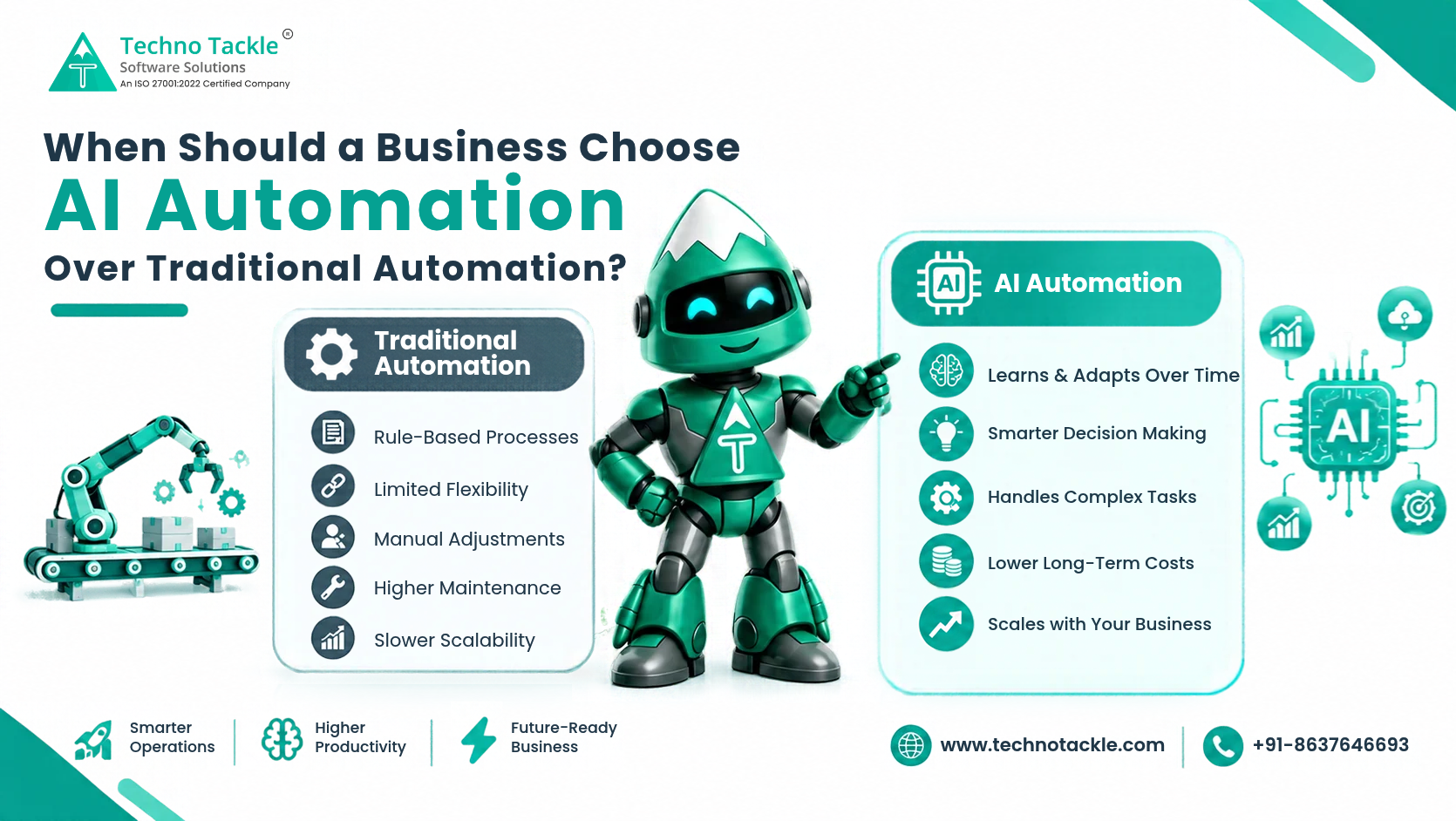
Ready-made AI tools are products you subscribe to. Think chat assistants, writing tools, meeting note takers, and AI features inside software you already use. You configure them, but you do not control how they work.
Custom AI development means building AI around your business. A team designs the system, connects it to your data and tools, sets the rules for what it can and cannot do, and tunes it over time. It may use existing models from providers such as OpenAI, Google, or Anthropic, but the system around them is yours.
Custom does not mean "train your own model from scratch." Most custom work builds on top of existing models. Training a model is rare and expensive, and most businesses do not need it.
When Ready-Made AI Tools Are the Right Choice
Start with a ready-made tool when:
-
The task is common. Drafting emails, summarising meetings, or generating first-draft copy are problems many tools already solve well.
-
You are still testing. If you have not yet proven that AI helps your team, a low-cost subscription is the cheapest experiment.
-
Your data is low risk. If nothing sensitive goes into the tool, privacy is less of a concern.
-
You need results this month. A tool can be live in days.
-
The workflow does not need to connect to your systems. Standalone use is simple to buy and simple to cancel.
Many businesses should stay here for a long time. There is no prize for building what you can buy.
When Custom AI Development Makes Sense
Consider custom AI development when one or more of these are true.
1. Your value sits in your own data
If the answers depend on your documents, records, or customer history, a generic tool cannot see them. A custom system can search your approved sources and answer from them, with the source shown. A well-built RAG solution is a common example.
2. The AI must work inside your systems
A tool that lives in a separate browser tab creates copy and paste work. If you need AI to read from your CRM, ERP, or database and act on what it finds, you need proper integration, login control, and logging.
3. Your data is sensitive or regulated
Healthcare, finance, legal, and similar fields often cannot send data to a third-party tool. Custom systems can run in a private environment, apply access control, and keep an audit trail.
4. Your process is specific to you
If your workflow has unusual steps, approvals, or rules, a generic product will force you to bend your process to fit it. A custom build bends to your process instead.
5. You need consistent, controlled output
Ready-made tools produce varied answers. A custom system can add guardrails, check outputs against rules, and send risky cases to a human.
6. The AI is part of your product or edge
If AI is what customers pay you for, renting the same tool as your competitors gives you no advantage. Custom AI solutions let you build something others cannot copy by signing up.
7. Usage will grow large
Per-seat and per-use pricing can climb fast at scale. At high volume, a custom system with cost controls can be cheaper. Run the numbers before you decide.
If two or three of these fit you, custom is worth a serious look. If none do, a tool is probably enough.
Cost and Time: A Fair Comparison
Ready-made tool:
-
Low start-up cost
-
Live in days
-
Partial fit to your workflow
-
Limited control over data
-
Subscription cost that grows with users
-
Low cost to switch
Custom build:
-
Higher start-up cost
-
Weeks to months to first use
-
Close fit to your workflow
-
High control over data
-
Build cost plus running and upkeep
-
Higher cost to switch
Ready-made tools win on speed and low entry cost. Custom builds win on fit and control. Neither is cheaper in every case.
Ask for a phased plan before you commit. A good partner will scope a small first release, prove value, and then expand. Our guide to custom AI agent development: cost and timeline explains what drives the numbers.
The Hidden Costs on Both Sides
Ready-made tools can hide costs in per-user fees, add-ons, workarounds, and staff time spent copying data between systems.
Custom builds can hide costs in vague scope, poor testing, and no plan for upkeep. AI systems need tuning after launch, because documents, prompts, and models change.
Whichever route you choose, measure the return. Our post on how to calculate ROI on technology projects gives a simple way to do it.
A Simple Decision Checklist
Answer yes or no to each.
-
Does the AI need your private data to be useful?
-
Does it need to connect to your own systems?
-
Is your data sensitive or regulated?
-
Is your process unusual enough that a generic tool does not fit?
-
Do you need strict control over what the AI says or does?
-
Is AI part of what you sell?
-
Will usage be large enough that subscription costs become a problem?
0 to 1 yes: use a ready-made tool. 2 to 3 yes: try a tool first, and plan a custom pilot for the strongest use case. 4 or more yes: custom AI development is likely the better fit.
Do Not Skip the Middle Path
You do not have to choose one side forever. Many businesses use a hybrid approach:
-
Use ready-made tools for common tasks such as writing and meeting notes.
-
Build custom for the one or two workflows where your data and process make the difference.
-
Start with a small pilot, measure the result, and expand only if it pays off.
If you are unsure where to begin, a short Gen AI consulting engagement can map use cases and rank them by value before you spend on a build.
For a deeper side-by-side view, see our post on custom Gen AI development vs off-the-shelf tools.
What to Check Before You Hire a Custom AI Partner
If the checklist points to custom, ask any vendor:
-
Can I talk to the engineers, not only sales?
-
How will you test answers for accuracy before launch?
-
Who owns the code, prompts, and model accounts?
-
How is my data stored, and who can see it?
-
What does support look like after go-live?
-
Can we start with a small pilot?
Be careful of anyone who promises a fixed accuracy number before seeing your data. No AI system is right every time. Good teams ground answers in your documents, show sources, and test against your real questions. If you are building agents, our page on testing AI agents explains why evaluation matters before launch.
Bottom Line
Choose ready-made AI tools when the need is common, the data is low risk, and you want results fast. Choose custom AI development when your data, systems, security needs, or competitive edge make a generic tool fall short.
Start small either way. Run a pilot, measure the result, and decide from evidence. If you want to explore a build, our custom AI development team can help you scope a first release around one clear use case.
Frequently Asked Questions
What is custom AI development?
It is the process of designing and building AI systems around a specific business, including its data, workflows, and rules. Most custom work uses existing models and builds the system around them.
What are custom AI solutions?
They are AI systems built for one organisation, such as a document assistant, an internal copilot, an automation workflow, or an agent that works inside your software.
Is custom AI development always more expensive than ready-made tools?
At the start, usually yes. Over time, it depends on scale, how well the tool fits, and how much manual work remains. Compare total cost, not only the first invoice.
How long does custom AI development take?
It depends on scope, data readiness, and integrations. A focused pilot can come together much faster than a full platform. Ask for a phased plan with a first release date.
Do we need our own AI model?
Usually not. Most business needs are met by building on existing models. Training your own is rarely needed and only makes sense when no available model can do the job.
Can custom AI keep our data private?
Yes, when designed for it. Options include access control, encryption, and private or on-premise deployment. Test the trade-offs, because private models may be less capable than the best cloud models.
Can we start with a ready-made tool and move to custom later?
Yes. Many teams do. Use the tool to learn what works, then build custom for the workflows where the tool falls short.
Not sure which route fits your business? That is a short conversation, not a long project.
Book a free 15-minute consultation with our team
Related reading: