November 8, 2024
In today's competitive tech landscape, software development staff augmentation has become one of the fastest-growing workforce strategies for companies that need to scale their teams quickly without the overhead of traditional hiring. Whether you are a startup racing to launch an MVP or an enterprise managing a multi-phase digital transformation, augmenting your development team gives you the skilled talent you need , exactly when you need it.
This guide covers everything you need to know about software development staff augmentation: what it is, how it works, its benefits, models, and how Techno Tackle helps companies like yours build high-performing teams on demand.
What Is Software Development Staff Augmentation?
Software development staff augmentation is a hiring model in which a company brings in external software professionals , developers, QA engineers, designers, or project managers , to work alongside its in-house team on a temporary or long-term basis.
Unlike Software development outsourcing, where an entire project is handed off to an external vendor, staff augmentation keeps you in control. The augmented professionals integrate directly into your team, follow your processes, attend your standups, and report to your project managers. You get the benefit of additional skilled hands without losing visibility or ownership of your project.
According to industry data, the global IT staff augmentation Services market is growing rapidly, driven by widening skill gaps and increasing demand for specialized software development expertise. Companies using this model report up to 30% reductions in total hiring costs compared to conventional recruitment.
How Does IT Staff Augmentation Work? A Step-by-Step Breakdown
The IT staff augmentation process is straightforward, but understanding each step helps you engage a provider like Techno Tackle more effectively:
1. Identify Skill Gaps: Audit your current team's capabilities and map them against project requirements. Note which skills are missing or understaffed.
2. Define Requirements: Specify the seniority level, technology stack, engagement duration, and time zone preferences.
3. Choose an Augmentation Partner: Work with a vetted staff augmentation company like Techno Tackle that pre-screens professionals for both technical skills and communication ability.
4. Interview and Select Candidates: Review shortlisted profiles, conduct technical interviews if needed, and make the hire in days , not months.
5. Onboard and Integrate: Augmented professionals are onboarded into your tools, workflows, and communication channels with minimal ramp-up time.
6. Deliver and Scale: Your expanded team delivers project milestones. Scale up or down as project demands change.
Top Benefits of Staff Augmentation for Software Development Teams
Here is why more software development companies are choosing staff augmentation over traditional hiring or full project outsourcing:
• Speed to hire: Access pre-screened developers within days, bypassing the typical 6–12 week recruitment cycle.
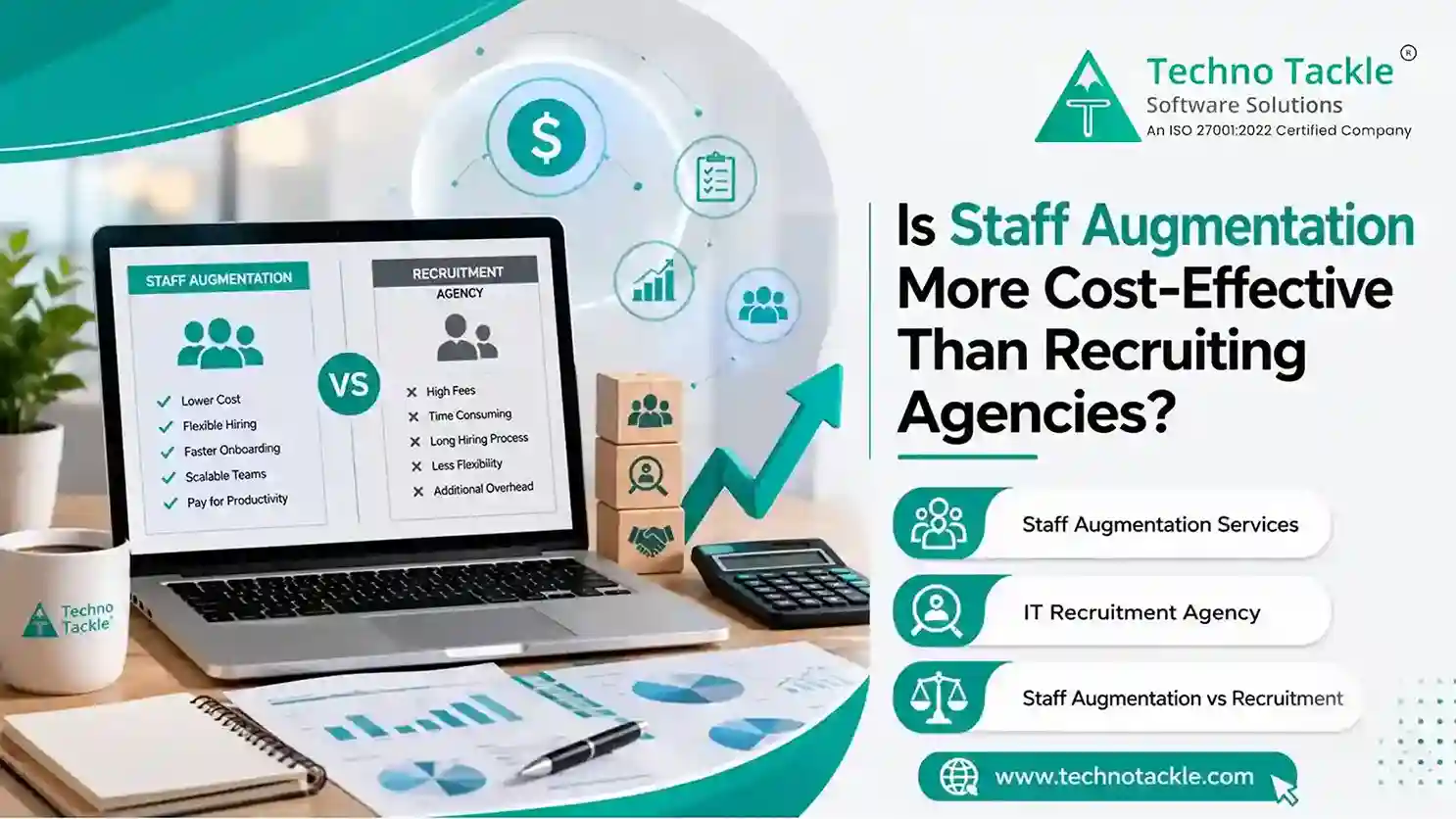
• Cost efficiency: Reduce hiring, onboarding, and benefits overhead. Studies show augmentation can cost up to 30% less than permanent hiring for the same role.
• Full control: Unlike outsourcing, you retain day-to-day management of the augmented team. They work your hours, in your tools, on your roadmap.
• Access to niche skills: Bring in specialists for specific technologies , React Native, cloud architecture, AI/ML, DevOps , without long-term commitment.
• Flexible scaling: Ramp teams up during peak delivery phases and scale down after launch without layoffs or severance considerations.
• Knowledge retention: Because augmented staff work within your team, institutional knowledge stays with your organization.
• Reduced risk: Trial high-performing contractors before offering permanent positions.
Staff Augmentation vs. Project Outsourcing: Key Differences
These two models are often confused but serve very different business needs. Here is a side-by-side comparison to help you decide:
|
Factor
|
Staff Augmentation
|
Project Outsourcing
|
|
Who manages the team?
|
You (in-house management)
|
The vendor manages independently
|
|
Best for
|
Filling skill gaps in ongoing projects
|
Delegating complete, defined projects
|
|
Cost model
|
Time & materials per resource
|
Fixed price or milestone-based
|
|
Flexibility
|
High , scale up/down as needed
|
Low , scope fixed at project start
|
|
Knowledge ownership
|
Stays with your company
|
May stay with vendor
|
|
Communication
|
Direct , your daily standups
|
Through vendor PM / reports
|
|
Time to start
|
Days to 2 weeks
|
Weeks to months (scoping phase)
|
|
IP & code ownership
|
Fully yours from day one
|
Needs contractual clarity
|
Bottom line: Choose staff augmentation when you need specific skills added to an existing team with full control retained. Choose outsourcing when you want to hand off an entire, well-scoped project to specialists.
Types of Staff Augmentation Models for Software Development
Not all software development staff augmentation engagements look the same. There are three primary models to consider:
Short-Term Augmentation
Typically 1–6 months, short-term engagements are ideal for project sprints, product launches, or covering team members on leave. Common for startups preparing an MVP release or companies managing seasonal development cycles.
Long-Term Augmentation
Engagements of 6 months or more, often with a dedicated team structure. Best for enterprises running multi-year digital transformation programmes where consistent expertise and deep codebase familiarity are critical.
Skill-Based Augmentation
Targeted augmentation of one or two highly specialized roles , such as a machine learning engineer, a cloud security architect, or a mobile accessibility specialist , that are difficult to hire permanently due to talent scarcity.
Roles Commonly Filled Through Software Development Staffing
Hire dedicated developers,Techno Tackle provides augmented professionals across the full software development lifecycle. The most requested roles include:
• Full-Stack Developers (React, Node.js, Python, Java, .NET)
• Frontend Developers (React, Vue, Angular)
• Backend Developers (APIs, microservices, database architecture)
• Mobile App Developers (iOS, Android, React Native, Flutter)
• Quality Assurance (QA) Engineers , manual and automation testing
• DevOps and Cloud Engineers (AWS, Azure, GCP, CI/CD pipelines)
• UI/UX Designers , prototyping, user research, design systems
• Project Managers and Scrum Masters
• Data Engineers and ML Specialists
• Cybersecurity Engineers
Each of these roles can be engaged on a project basis, giving your development team the precise expertise needed at each phase , from initial design through deployment and ongoing maintenance.
Common Challenges in Staff Augmentation (and How to Overcome Them)
Staff augmentation is highly effective, but it does require deliberate management to deliver maximum value. Here are the most common challenges and how to address them:
Challenge 1: Communication Friction
When augmented professionals are remote or across time zones, miscommunication can slow delivery. Solution: Establish daily async updates, clear documentation standards, and a designated in-house point of contact for each augmented team member.
Challenge 2: Integration With Existing Teams
Augmented developers need time to understand your codebase, tooling, and culture. Solution: Invest in a structured 3–5 day onboarding process covering code standards, architecture docs, and team rituals. Techno Tackle pre-briefs professionals on client expectations before day one.
Challenge 3: Management Overhead
Managing distributed contributors takes effort. Solution: Assign a dedicated internal tech lead to interface with augmented staff. Use Jira, Linear, or equivalent project management tools to keep all contributors aligned on sprint goals.
Challenge 4: Security and IP Concerns
External professionals accessing internal systems creates potential exposure. Solution: Use role-based access controls, NDAs from day one, and enforce security standards through onboarding checklists.
Case Study: 25% Cost Reduction & 35% Productivity Gain
A mid-sized technology firm was struggling to meet the launch deadline for a critical enterprise application. Their internal team lacked capacity in both backend development and QA automation.
Using Techno Tackle's software development staff augmentation service, they added three senior developers and two QA automation engineers within nine days. The augmented team integrated seamlessly with the client's existing Agile sprints.
The results after 90 days:
• 25% reduction in total hiring and resource costs compared to the original recruitment plan
• 35% improvement in team productivity as measured by sprint velocity
• Product launched on schedule , the first on-time delivery in 18 months
• Two of the augmented engineers were converted to permanent hires following project completion
This engagement demonstrated what well-executed software development team augmentation can deliver: speed, cost control, and measurable quality improvement.
Future of IT Staff Augmentation: Trends to Watch Through 2030
The software development staffing industry is evolving rapidly. Here are the key trends shaping the future of staff augmentation:
• AI-assisted talent matching: Platforms now use machine learning to match developer profiles with project requirements in hours rather than days, reducing time-to-hire significantly.
• Rise of specialized AI and ML augmentation: As AI integrations become standard in software products, demand for augmented ML engineers, LLM specialists, and AI-adjacent roles is accelerating.
• Asynchronous-first distributed teams: Companies are redesigning collaboration workflows to support high-performing globally distributed augmented teams, with asynchronous documentation replacing many real-time meetings.
• Outcome-based engagement models: Clients are moving beyond hourly billing toward milestone and outcome-based pricing for augmented professionals, aligning vendor incentives with project success.
• Niche platform specialization: Augmentation providers are developing deep talent pools in specific verticals , fintech, healthtech, AI , rather than generalist recruitment.
By 2030, industry analysts expect IT staff augmentation to be the primary talent strategy for software development at enterprises running more than three concurrent digital initiatives simultaneously.
FAQ: Software Development Staff Augmentation
What is the difference between staff augmentation and managed services?
Staff augmentation provides individual professionals who work under your direction. Managed services provide a full team or function operated independently by the provider with defined SLAs. Augmentation suits companies wanting control; managed services suit companies wanting to fully delegate a function.
How quickly can I onboard an augmented developer?
With a partner like Techno Tackle, typical time from brief to first day is 5–10 business days, depending on seniority and technology stack. Pre-screened talent pools eliminate the initial sourcing phase.
Is software development staff augmentation suitable for startups?
Absolutely. Startups benefit significantly because they gain senior expertise without committing to full-time salaries during uncertain growth phases. Augmented developers can help you build, launch, and iterate your product with professional-grade engineering.
What happens to the code and IP when using augmented staff?
All code written by augmented professionals under contract belongs to your company. A properly structured engagement includes IP assignment clauses in the contract, which Techno Tackle includes as standard.
Can I convert an augmented developer to a permanent hire?
Yes. Many clients choose to convert high-performing augmented developers to permanent positions after a trial period. This arrangement is typically covered by a conversion clause in the engagement contract.