IT Staff Augmentation In-house developer hiring costs compared to software development staff augmentation

July 6, 2026

The Hidden Costs of Hiring In-House Developers Compared to Software Development Staff Augmentation

Every engineering leader knows that hiring the right developer takes time. What most budgets fail to account for is just how much that time costs , and how quickly those costs compound before the new hire writes a single line of code.

When you look beyond the salary line, in-house hiring carries a set of financial and operational burdens that rarely appear in a headcount plan. Meanwhile, software development staff augmentation has matured into a credible, high-quality alternative that removes most of those burdens without removing your control over the work.

This guide breaks down every cost layer of in-house developer hiring, compares it honestly against staff augmentation, and helps you decide where each model fits in your organisation's growth plan.


Why the True Cost of In-House Hiring Is Always Higher Than It Looks

The salary figure on an offer letter is the visible tip of a much larger iceberg. Most hiring managers are aware of recruiter fees and benefits. Far fewer account for the compounding effect of lost time, management overhead, and the cost of a bad hire.

Layer 1: Direct Recruitment Costs

Recruitment for a mid-to-senior software developer typically involves one or more of the following:

  • Recruitment agency fee: 15–20% of first-year salary , for a developer earning ₹15 LPA, that is ₹2.25–₹3 lakhs before they start

  • Job board advertising: ₹30,000–₹80,000 per posting across Naukri, LinkedIn, and similar platforms

  • Internal HR time: 20–30 hours of sourcing, screening, and coordinating interviews across multiple rounds

  • Technical assessment tools: Platforms like HackerRank or Codility add ₹15,000–₹40,000 per hire in subscription or per-test costs

None of these appear in a salary budget, but every rupee is real. If you want a detailed breakdown of how these costs accumulate and damage team productivity, our post on the hidden costs of IT turnover lays it out clearly.

Layer 2: Compensation Beyond Base Salary

The offer letter salary is only part of what an employer actually pays. Add:

  • Provident Fund (PF): 12% of basic salary, employer contribution

  • Gratuity: Accrues from day one, payable after 5 years

  • Health insurance: ₹15,000–₹40,000 per employee per year depending on coverage

  • Performance bonus or variable pay: Typically 10–20% of CTC

  • Equipment: Laptop, monitor, and software licences , ₹75,000–₹1,20,000 upfront

  • Infrastructure: Desk space, electricity, internet, and facilities overhead

When you stack these together, the total employer cost for a developer with a ₹15 LPA CTC typically runs between ₹19–₹22 LPA in real outflow.

Layer 3: Onboarding and Ramp-Up Time

This is the cost that almost no one measures , and it is one of the largest.

A new in-house developer does not become fully productive on day one. Research consistently shows that a mid-level software engineer takes 3–6 months to reach full productivity in a new environment. During that period:

  • Senior engineers spend significant time reviewing PRs, answering questions, and pair programming

  • Sprint velocity drops for the whole team during onboarding sprints

  • Architecture decisions may be delayed while the new hire learns the codebase

If your team is working on a 6-month project and your new hire takes 3 months to ramp up, you have consumed half the project timeline before getting full value.

This is a central reason why companies that need to hire remote developers for time-bound projects increasingly turn to augmentation , pre-vetted professionals who already know the technology stack arrive ready to contribute in days, not months. Our guide on why staff augmentation matters for software development explains this distinction in detail.

Layer 4: The Cost of a Bad Hire

Not every hire works out. Skill mismatches, cultural fit problems, and changing project requirements all create situations where the role needs to be refilled. The cost of a failed hire includes:

  • Severance pay (typically 1–3 months of salary)

  • Restarting the recruitment cycle: another 60–90 days and another agency fee

  • Project delay costs: deadlines missed while the team is understaffed

  • Team morale damage: remaining developers absorb extra work and stress

Industry estimates put the total cost of replacing a mid-level software developer at 50–100% of their annual salary. On a ₹15 LPA role, that is ₹7.5–₹15 lakhs of unplanned spend , plus the opportunity cost of what the team could not ship during the gap. Our article on why developers leave and how to retain them explores the retention side of this equation.


The Full Cost Comparison: In-House vs Staff Augmentation

Let's put concrete numbers against a real scenario. Assume a company needs a senior full-stack developer for a 6-month product build.

In-House Hiring (6-Month View)

When you hire a full-time senior developer at ₹18 LPA, the six-month gross CTC alone comes to ₹9,00,000. But that is only where the spending starts. Add the employer's contribution to PF, gratuity, and insurance at ₹1,20,000, a recruitment agency fee of 18% on the annual CTC which works out to ₹3,24,000, equipment and software licence costs of around ₹90,000, and a conservative estimate of ₹1,50,000 for onboarding and the productivity loss during the first three months of partial output. Stack all of that together and the true six-month cost of a single in-house hire reaches ₹15,84,000 , nearly double what the salary figure alone would suggest.

Software Development Staff Augmentation (6-Month View)

With staff augmentation, the picture looks entirely different. The resource cost for the same six-month engagement runs between ₹6,00,000 and ₹8,40,000 depending on the technology stack and seniority level. There is no recruitment agency fee, no statutory benefit obligation, and no equipment procurement cost on your side. Infrastructure and onboarding expenses are minimal, and the developer is typically contributing to your codebase within one to two weeks of engagement. The total six-month outflow stays between ₹6,00,000 and ₹8,40,000 , nothing hidden, nothing deferred.

That is a saving of 47–62% on a single role for a single project. And when the project ends, there is no severance conversation, no notice period cost, and no open headcount sitting on your books waiting to be backfilled.


What You Keep When You Choose Staff Augmentation

A common concern about moving away from in-house hiring is losing control. This concern is understandable, but it misunderstands how software development staff augmentation actually works.

Unlike outsourcing , where you hand over a project and receive a deliverable , augmentation places vetted developers inside your team. They:

  • Attend your standups and sprint planning sessions

  • Work within your ticketing system and version control

  • Report to your engineering leads

  • Follow your coding standards and review process

You retain full control of the work. The difference is that the administrative and compliance overhead , payroll, benefits, tax filings, equipment procurement , moves off your plate entirely.

For a clear distinction between augmentation and outsourcing, see our comparison of staff augmentation vs. outsourcing for US startups , the same logic applies regardless of geography.


Roles That Benefit Most From Team Augmentation Services

Not every role is equally suited to augmentation. Here is a breakdown of where team augmentation services deliver the clearest advantage over in-house hiring.

High-Impact Augmentation Use Cases

1. Specialised Technical Roles Skills like AI/ML engineering, DevOps, cloud architecture, and mobile development are expensive and slow to hire for in-house. When you need to hire remote developers with niche expertise, augmentation gives you access to a pre-screened talent pool that would take months to source independently. Our guide to hiring MERN stack developers is a good example of how specific this matching can get.

2. Fixed-Term Product Builds When a project has a defined start and end , a 4-month MVP build, a platform migration, a product launch sprint , a dedicated development team through augmentation fits the scope precisely. A dedicated development team engaged this way gives you the speed of a seasoned squad without the overhead of hiring each member permanently. You scale up for the build, then scale down cleanly. No redundancy process. No severance conversation.

3. Immediate Scaling Needs When a delivery deadline is approaching and your in-house team needs reinforcement fast, the 60–90 day traditional hiring cycle is not an option. Team augmentation services can place qualified engineers in your workflow in 1–2 weeks.

4. Technology Transitions Migrating from a legacy stack to a modern one often requires skills your existing team does not have. Bringing in augmented specialists for the transition period means your core team learns alongside experts without the long-term headcount commitment. See our piece on what locks companies into legacy systems for context on why these transitions are often delayed.

5. Small and Mid-Size Businesses For companies that cannot absorb the fixed cost of a full in-house engineering team, augmentation allows access to senior talent on a flexible basis. Our post on staff augmentation benefits for small enterprises goes into detail on why this model works particularly well at that scale.


The Hybrid Model: Where In-House and Augmentation Work Together

The goal is not to replace every in-house hire with an augmented developer. Permanent hires make sense for roles that require long-term institutional knowledge, cultural leadership, and strategic continuity.

The smartest engineering organisations use a hybrid approach:

Hire in-house for:

  • Core architecture and product vision roles

  • Engineering leadership and technical mentorship

  • Roles where cultural context and long-term continuity matter

Use software development staff augmentation for:

  • Specialised skills needed for a defined period

  • Rapid team scaling during launches or high-pressure sprints

  • Technology-specific expertise where you need to hire remote developers with niche stacks rather than train existing team members

  • Projects where the fastest path is to hire remote developers on a flexible contract rather than open a permanent headcount

This model is not new, but it is increasingly the default at companies that have experienced the true cost of trying to hire every skill in-house. If you want a framework for choosing between models for a specific initiative, our guide on choosing the right engagement model for software development gives you a structured decision process.


Five Hidden Costs That Never Appear in a Hiring Budget

To summarise the costs that in-house hiring generates but rarely gets credit for:

1. Engineering Leader Time Technical interviews, code reviews, and onboarding mentorship for a new hire consume 15–20% of a senior engineer's time for 2–3 months. That is time not spent building the product.

2. Delayed Project Timelines Every week a role is open is a week of reduced team capacity. And if you need a dedicated development team rather than a single hire, multiply that delay across every unfilled seat. On a 6-month project, a 90-day hiring cycle means the team is already halfway through the timeline before the new hire is even onboarded.

3. Compliance and HR Administration Managing payroll, statutory filings, insurance claims, performance reviews, and exit processes for each in-house developer creates ongoing administrative overhead. With team augmentation services, the vendor carries this entirely.

4. Attrition and Re-Hiring Cycles Developer attrition is high across the industry. Every time a developer leaves, the recruitment cycle, onboarding cost, and productivity gap repeat. Augmented developers are engaged for defined terms with clear expectations on both sides , reducing the surprise attrition that damages team momentum.

5. Opportunity Cost The most invisible cost of all. Every month spent on hiring cycles, onboarding, and managing underperforming hires is a month your competitors used team augmentation services to ship features, win customers, and grow. You cannot put a precise number on missed market opportunities , but they are real.


How Techno Tackle Makes the Switch Simple

At Techno Tackle, our IT staff augmentation services are built to eliminate the hidden costs of in-house hiring without reducing your control over the work. You get a dedicated development team that feels entirely in-house , because day-to-day, it is.

What we handle for you:

  • Pre-screening and technical vetting across 40+ stacks

  • Skills matching aligned to your exact project requirements

  • Payroll, compliance, and HR administration

  • Seamless onboarding support and dedicated account management

  • Transparent, fixed monthly pricing , no surprise fees

What you retain:

  • Full direction over day-to-day work

  • Engineering leadership and code review authority

  • Architecture and product decision ownership

Whether you need a single specialist or a complete dedicated development team for a product build, our model is designed to plug directly into your workflow within 1–2 weeks. If you are evaluating providers, our roundup of top IT staff augmentation companies for hiring dedicated developers gives you a useful benchmark.

For companies that need ongoing delivery management in addition to staff augmentation, our managed IT outsourcing services offer a broader engagement model where we own delivery accountability end to end.


The Bottom Line

When you account for every layer , recruitment fees, statutory costs, equipment, ramp-up time, attrition risk, and management overhead , in-house developer hiring consistently costs more than it appears on paper. For permanent, strategic roles, that cost is often justified. For time-bound projects, specialised skill gaps, and scaling needs, it rarely is.

The smarter path is to hire remote developers through a trusted augmentation partner and keep permanent headcount for roles where it is genuinely warranted. Staff augmentation solves the hidden cost problem by giving you access to vetted, deployable talent on flexible terms , without the administrative burden, the 90-day hiring cycle, or the financial risk of a bad hire.

The companies winning on speed and quality today are not choosing between in-house and augmentation. They are using both , deliberately, and for the right reasons.


See How Much You Can Save on Your Next Technical Hire

Book a 15-minute free consultation call with the Techno Tackle team and get a clear cost comparison for your specific situation.

Schedule a Call on Calendly 

Read more
IT Staff Augmentation Comparison of traditional hiring costs vs IT staff augmentation savings

June 26, 2026

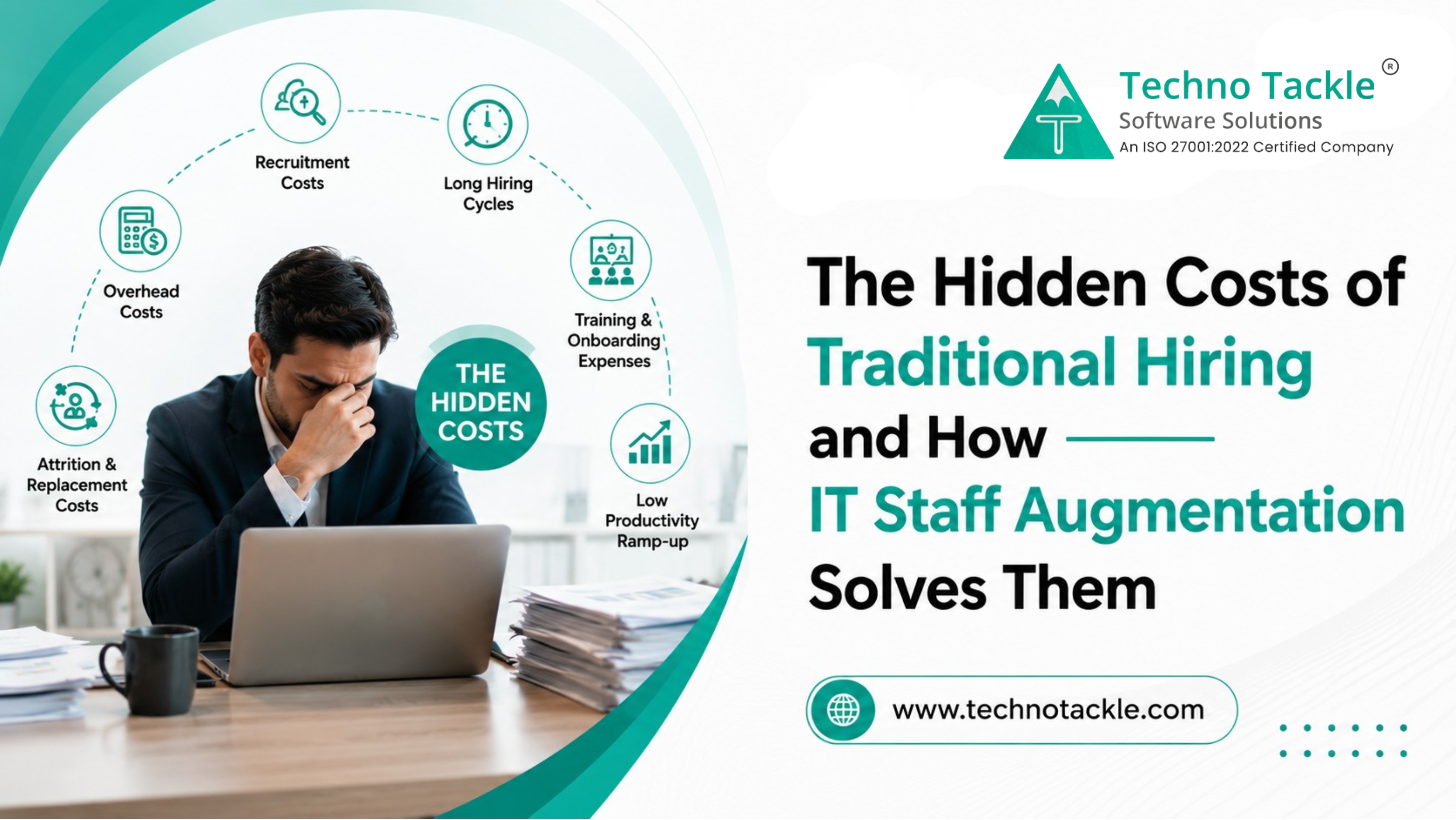
The Hidden Costs of Traditional Hiring and How IT Staff Augmentation Solves Them

"Building a great technology team is no longer just about finding the right people,it’s about finding them at the right time."

Every vacant position can lead to delayed projects, increased pressure on existing teams, and missed business opportunities. Yet these costs rarely appear in hiring budgets.

As technology continues to evolve rapidly, businesses need faster and more flexible ways to access skilled talent. This is exactly where software development staff augmentation is changing the game,giving engineering leaders a way to plug skill gaps without the long wait times of conventional recruitment.


The True Cost of Traditional Hiring

When you decide to hire a full-time engineer, you’re not just paying a salary.

Direct costs include:

  • Recruitment agency fees: 15–20% of annual salary

  • Onboarding & training: 2–4 weeks of lost productivity

  • Benefits, taxes, and overhead: 20–30% above base salary

  • Compliance and legal: Administrative burden and risk

But the real killer? Time.

An average hire takes 60–90 days from job posting to day one. Then add 3–6 months for full productivity. That’s nearly a year before you’re getting true ROI. Meanwhile, your project timelines slip, your engineering leaders are spending 20% of their time on hiring instead of building, and competitors aren’t waiting for you to staff up.

And if the hire doesn’t work out,skill mismatch, cultural fit issues, or simply changing project needs,you’re looking at another 3–6 months to recruit a replacement, plus severance costs and damage to team morale. If you want a closer look at how this plays out in numbers, our breakdown on the hidden costs of IT turnover is worth a read.

The biggest cost isn’t the hiring expense,it’s the time and opportunities lost along the way.


Why Traditional Hiring Breaks Modern Teams

The fundamental problem: business needs are changing faster than traditional hiring processes can respond.

Traditional recruitment assumes:

  • You know exactly what skills you need from the start

  • You can hire specialists as full-time employees, even for short-term projects

  • Talent must be located near your office

  • Your business needs will remain the same for year


Startups may need skilled developers for a short period, but hiring them full-time can be costly. Large companies may have permanent teams, but adding or reducing resources quickly can be difficult.

As technology and business needs change rapidly, organizations need a more flexible way to build teams,one where they can hire remote developers on demand instead of being locked into rigid headcount plans. If you’re unsure which model fits your situation, this guide on choosing the right engagement model for software development breaks it down clearly.


How IT Staff Augmentation Changes the Hiring Equation

Staff augmentation isn’t outsourcing. It’s not offshoring. It’s a strategic skill extension.

You hire vetted, pre-screened talent on flexible terms. They integrate directly into your team. Your engineering leaders manage them. You control the work. The difference? You only pay for what you need, when you need it.

Here’s how it actually works:

1. Identify your skill gap (AI/ML engineer, DevOps specialist, full-stack developer)

2. Get matched with vetted talent in 1–2 weeks

3. Onboard and scale with minimal overhead

No recruiter fees. No 90-day hiring cycles. No guessing if they’ll fit. If you’re new to the concept, our explainer on what IT staff augmentation actually means is a good starting point, and this piece on why staff augmentation matters for software development goes deeper into the strategic case.

It’s worth noting that staff augmentation is different from working with a fully outsourced dedicated development team,you retain day-to-day control, while a dedicated team operates more independently under a vendor’s management. We’ve compared both models in detail in staff augmentation vs. outsourcing for US startups.


Why It Works: Five Key Advantages

1. Faster Project Execution , Get skilled professionals onboard in 1–2 weeks instead of waiting months for a new hire. This helps projects move faster and improves time-to-market.

2. Access to Specialized Skills , Need expertise in AI, DevOps, Cloud, or Full-Stack Development? Staff augmentation gives you quick access to experienced professionals when you need them,including the option to hire remote developers with niche, hard-to-find skill sets like MERN stack expertise. Our guide to hiring MERN stack developers shows what to look for.

3. Flexible Team Scaling , Scale your team up or down based on project requirements without the challenges of permanent hiring.

4. Reduced Hiring Risk , Work with pre-screened professionals who are ready to contribute, reducing the risk of hiring the wrong candidate.

5. More Time for Core Business , Your managers can focus on delivering projects and driving innovation instead of spending time on recruitment and onboarding.


The Hybrid Workforce Advantage

CTOs and engineering managers aren’t abandoning traditional hiring entirely. They’re being smarter about it.

They hire full-time for:

Core product vision & architecture roles

Long-term strategic positions

Leadership & mentorship roles

They augment for:

Specialized technical needs

Temporary scaling (launches, sprints)

Niche expertise (AI/ML, infrastructure, security)

Time-sensitive projects

This hybrid model gives you the best of both worlds: stability where it matters, flexibility where it’s needed. Many of these same companies also lean on managed IT outsourcing services for ongoing operational needs while using software development staff augmentation for project-specific skill gaps,blending both models based on what each initiative actually demands.


How Techno Tackle Makes It Simple

At Techno Tackle, we specialize in matching engineering teams with vetted IT talent in 1–2 weeks.

What we handle: 

Pre-screening and vetting (you get quality, not quantity)

Skills matching aligned to your exact needs

Seamless onboarding support

Dedicated account management

Transparent, predictable pricing (no hidden fees)

Why teams choose us: We understand engineering. We don’t just place bodies,we match expertise to culture. Your augmented staff feels like your dedicated development team because they are your team.

Whether you need a single specialist or a full squad, our IT staff augmentation services are built to plug into your existing workflow without the overhead of traditional hiring. And if you’re comparing providers before deciding, this roundup of top IT staff augmentation companies for hiring dedicated developers can help you evaluate your options.


Who Should Consider Team Augmentation Services?

Not every hiring need calls for the same solution. Here’s a quick way to think about it:

Startups racing toward an MVP or a funding milestone often need a dedicated development team fast, without the 3–6 month lead time of building one internally.

Mid-sized companies scaling a specific product line can use team augmentation services to add senior talent for a quarter or two, then scale back down.

Enterprises running parallel digital transformation initiatives can use staff augmentation to avoid overloading their core teams while keeping strategic roles in-house.

In every one of these cases, the common thread is the same: businesses need to hire remote developers quickly, without compromising on quality, control, or budget predictability.


Common Mistakes Companies Make When Evaluating Staff Augmentation

Even when leaders recognize the value of flexible hiring, a few avoidable mistakes often get in the way:

1. Treating it as a “cheap outsourcing” shortcut.

Some teams expect software development staff augmentation to work like a low-cost outsourcing arrangement, where they hand off a project and walk away. In reality, the model works best when your engineering managers stay actively involved,reviewing code, running standups, and setting priorities,just as they would with any in-house hire.

2. Skipping the skills-matching step.
Rushing to fill a seat without clearly defining the skill gap often leads to mismatches. A good partner will take the time to understand whether you genuinely need a dedicated development team for a multi-month build, or just one or two specialists to plug a short-term gap.

3. Ignoring time zone and communication overlap.

When you decide to hire remote developers, overlap hours matter. Even a couple of hours of daily overlap for standups and code reviews can make the difference between a smooth integration and a frustrating one.

4. Not having a clear offboarding plan.

One of the biggest advantages of team augmentation services is the ability to scale down cleanly when a project ends. Companies that don’t plan for this upfront sometimes end up extending contracts out of inertia rather than genuine need, eroding the cost advantage.

5. Underestimating documentation needs.

Augmented developers integrate faster when your codebase, ticketing system, and architecture decisions are reasonably well documented. A little investment here pays off quickly in onboarding speed.


Frequently Asked Questions

Is staff augmentation only for short-term projects?

No. While it’s ideal for time-boxed needs like a six-month build, many companies keep augmented developers on their team for a year or longer, especially for ongoing product work where headcount flexibility still matters.

How is this different from hiring freelancers?

Freelancers are typically self-managed and juggle multiple clients. With staff augmentation, the developer is vetted, dedicated to your team during their engagement, and managed the same way you’d manage any other member of your dedicated development team.

Can we convert an augmented developer to a full-time employee later?

In many cases, yes. If a working relationship goes well and a permanent role opens up, transitioning an augmented team member to a direct hire is usually straightforward,you’ve already seen their work firsthand.

What roles are best suited to augmentation versus full-time hiring?

Specialized, project-bound, or rapidly evolving skill needs (AI/ML, DevOps, cloud migration, niche frameworks) are well suited to augmentation. Core architecture, product leadership, and long-term strategic roles are usually better served by full-time hires.

How quickly can we actually get started?

With a clear skill requirement, most engagements through team augmentation services can move from initial conversation to a working developer on your team within 1–2 weeks,a fraction of the 60–90 day timeline of traditional recruitment.


The Bottom Line

Traditional hiring continues to be valuable for long-term and strategic roles. However, modern businesses need the flexibility to respond quickly to changing project requirements, emerging technologies, and market demands. Software development staff augmentation helps organizations bridge skill gaps, accelerate project delivery, and scale teams without the delays and costs associated with traditional hiring.

Key Benefits:

Faster access to skilled talent

Lower recruitment and onboarding costs

Greater flexibility to scale teams

Quick access to specialized expertise

Reduced hiring risks

Faster project delivery and time-to-market

More focus on innovation and business growth

Organizations that combine permanent hiring with staff augmentation are better positioned to stay agile, competitive, and future-ready.


Final Thought

The hiring landscape has changed permanently. Project timelines are shorter, technology stacks evolve faster, and the cost of a slow hire is higher than ever. Companies that lean on software development staff augmentation to fill specialized, time-bound roles,while still investing in full-time hires for leadership and core architecture,consistently move faster than competitors stuck in the old 90-day hiring cycle.

If your roadmap for the next two quarters includes a project that needs extra hands, the smartest first step is simply talking to a team that can show you real numbers for your specific situation. Whether the need is a single specialist or a small squad ready to hire remote developers into your existing sprint cadence, getting a clear picture of cost and timeline takes less time than writing one job description.

Ready to See the Savings for Yourself?

Book a 15-minute free consultation call with the Techno Tackle team to see how much you can save on your next technical hire.

Schedule a Call on Calendly →

Read more
IT Staff Augmentation IT staff augmentation engineers collaborating within an agile development team during a sprint planning session

June 10, 2026

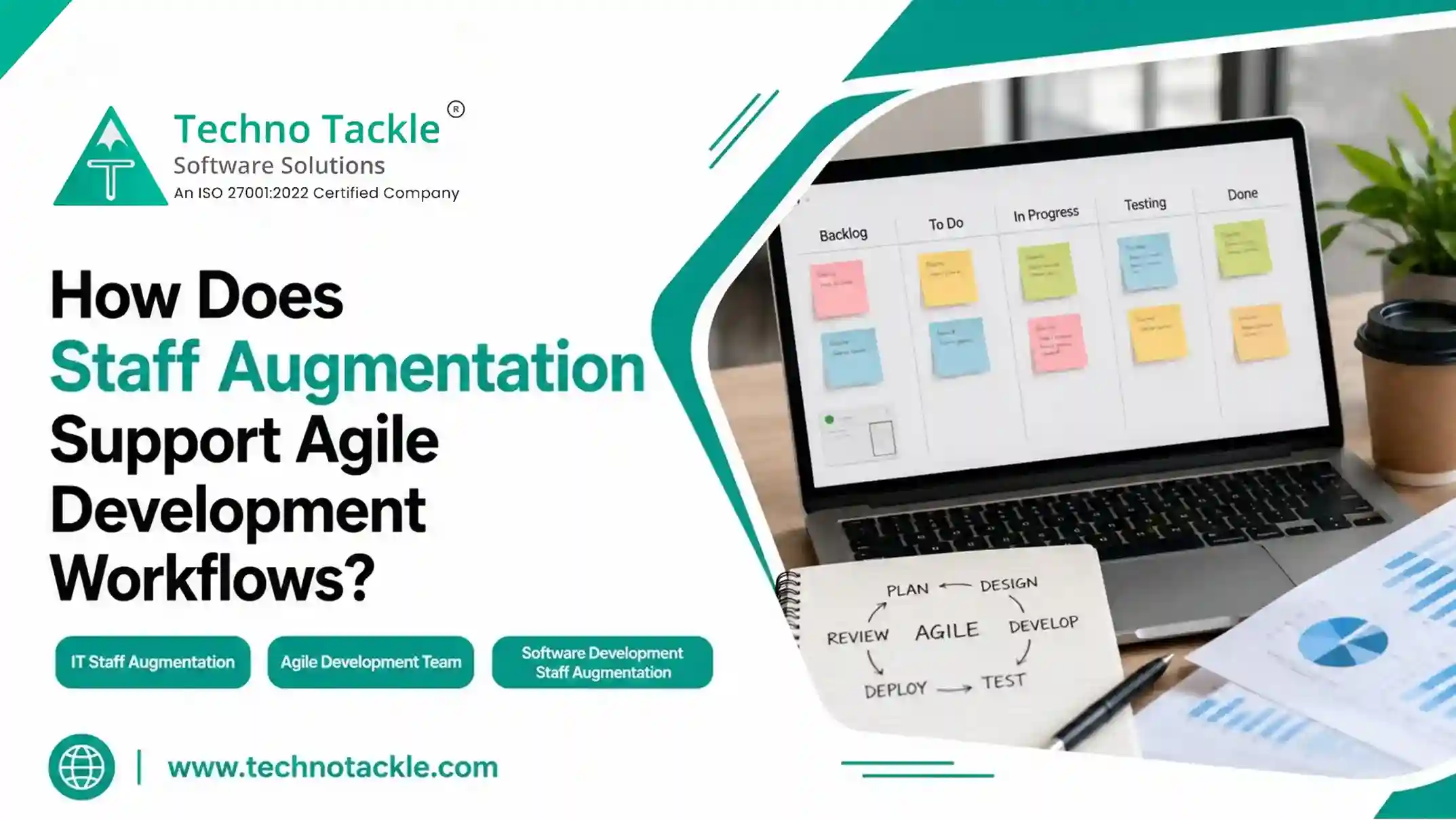
How Does IT Staff Augmentation Support Agile Development Workflows?

You hired smart engineers. You have a product roadmap. But somewhere between sprint planning and delivery, things break down. The team is stretched. Deadlines slip. Skilled developers are hard to find and even harder to retain.

This is the reality most tech founders face in 2026. And it is the exact problem IT staff augmentation was built to solve.

In this guide, we break down how IT staff augmentation integrates with agile development workflows, why it works, where it fails, and how TechnoTackle helps companies deploy augmented teams that actually deliver.


What Is IT Staff Augmentation?

IT staff augmentation is the practice of bringing in external developers, engineers, or technical specialists to work directly within your existing team. These professionals operate under your direction, follow your sprints, and use your tools. They are not a third-party agency running a parallel project. They are your team, temporarily expanded.

Unlike outsourcing, where you hand off a deliverable and wait, IT staff augmentation keeps you in full control. You set the priorities. You run the standups. You own the codebase.

This matters more in agile environments where daily collaboration, fast feedback loops, and iterative progress are not optional; they are the whole point.


Agile Teams Break Down Without the Right People

Agile development is built on speed and adaptability. Short sprints. Continuous delivery. Rapid iteration. But agile only works when your team has the bandwidth and the skills to execute.

Here is where most teams run into trouble:

  • A critical sprint requires a React Native specialist. Your team does not have one.
  • A product launch is six weeks out. You need three more backend engineers now, not in four months.
  • Your senior dev just left. Institutional knowledge walked out the door with them.
  • Your roadmap has evolved. The stack you planned for six months ago needs new expertise.


Standard hiring cannot fix these problems in time. A typical engineering hire takes 45 to 90 days. By the time the candidate starts, the sprint has already failed.

This is the gap IT staff augmentation closes.


Ready to scale your agile development team without the hiring delay?

Book a 30-minute call with our team. We will have matched profiles in front of you within 48 hours.

Schedule a Free Call with TechnoTackle


How IT Staff Augmentation Supports Agile Development Workflows


1. Scales Your Agile Development Team on Demand

Agile is designed for change. Your team size should be, too. IT staff augmentation lets you scale your agile development team up during peak sprints and scale down when the workload normalises. You are not paying for idle capacity, and you are not scrambling when demand spikes.

TechnoTackle maintains a bench of pre-vetted engineers across full-stack, mobile, DevOps, QA, and cloud disciplines. When you need capacity, we move fast.


2. Fills Specialist Skill Gaps Without Long-Term Commitment

Not every project needs a permanent hire. Software development staff augmentation gives you access to specialists, think Kubernetes engineers, ML developers, or blockchain architects, for the duration of a specific sprint or release cycle. When the work is done, the engagement ends. No severance, no bench cost, no friction.

This is particularly valuable in agile workflows where the tech stack can shift between product phases.


3. Accelerates Sprint Delivery

More capacity means faster cycles. Augmented engineers slot into your existing sprint structure, pick up tickets, join stand-ups, and ship code. There is no ramp-up on methodology. They are already trained in agile practices.

TechnoTackle engineers are onboarded with agile fluency by default. They know Jira, Confluence, GitHub, and how to operate inside a two-week sprint without disrupting team rhythm.


4. Reduces Risk During Critical Releases

The closer you get to a major release, the more expensive a skills gap becomes. Software development staff augmentation lets you reinforce the team exactly when the stakes are highest. You bring in the right people for the release window and then transition back to core team size.

TechnoTackle has supported multiple high-stakes release cycles for SaaS, fintech, and healthcare tech clients. We know how to get engineers productive in days.


5. Keeps Development Momentum During Team Transitions

Someone resigns. A key engineer goes on parental leave. A team restructure disrupts delivery. These events happen, and in agile environments, even a one-sprint disruption can cascade into a three-month delay.

IT staff augmentation gives you a continuity option. Bring in a replacement with the same skill profile within a week. Keep the sprint moving. Avoid knowledge loss by overlapping the incoming and outgoing engineer.


How TechnoTackle Solves the Integration Problem

Most IT staff augmentation fails for one reason: the augmented engineer does not actually integrate. They work in isolation, miss context, and slow the team down rather than accelerating it.

TechnoTackle takes a different approach.


Pre-Vetted for Agile Fluency

Every engineer in our network has been assessed not just for technical skills but for communication, async collaboration, and agile workflow compatibility. We do not place developers who need hand-holding on basic practices.


Rapid Onboarding Protocol

We have a structured onboarding checklist that gets augmented staff productive within 48 to 72 hours. Codebase orientation, tool access, sprint context, and communication norms are covered before the first standup.


Dedicated Account Management

You get a dedicated point of contact who monitors fit, performance, and communication health throughout the engagement. If something is not working, we fix it fast or replace the engineer. No drawn-out performance management processes.


Transparent Pricing. No Hidden Costs.

Our software development staff augmentation engagements are priced per role per month. No placement fees, no surprise markups. You know the cost before the first line of code is written.


Explore More From TechnoTackle

If you are evaluating whether IT staff augmentation is the right model for your team, these resources from TechnoTackle will give you the context to decide:


IT Staff Augmentation Services - Overview of our engagement models, roles we place, and how pricing works.

Hire Dedicated Developers - Find pre-vetted developers available to start within days.

Software Development Services - Full-cycle development support for product teams at every stage.

Agile Development Teams - How TechnoTackle builds and supports high-velocity agile teams.

Case Studies - Real results from clients who scaled with TechnoTackle.


When IT Staff Augmentation Is the Right Call

Not every situation calls for staff augmentation. Here is a direct assessment:


Use IT staff augmentation when:
  • You need a specialist skill for one to three sprints.
  • A key team member has left and you cannot wait 60 days to replace them.
  • You are scaling a product and need to triple team size within weeks.
  • You want to keep control of delivery but lack internal capacity.
  • You are entering a new technical domain, cloud migration, AI integration, mobile, and need domain expertise fast.


Do not use IT staff augmentation when:
  • You need a long-term culture carrier. Hire permanently for core roles.
  • You do not have the internal structure to manage and direct external engineers.
  • Your codebase has no documentation and onboarding takes three months. Fix the documentation first.


Common Mistakes Teams Make With Software Development Staff Augmentation


Mistake 1: Treating Augmented Engineers Like Outsourced Vendors

Augmented staff are not a black box. They need sprint context, access to Slack, inclusion in retrospectives, and clear ticket ownership. If you manage them like a third-party vendor, they will perform like one.


Mistake 2: Skipping the Onboarding

A two-day investment in proper onboarding saves two weeks of misaligned work. Give augmented engineers a codebase walkthrough, a sprint history summary, and a clear first week of tickets. TechnoTackle provides an onboarding framework for every placement to make this easier.


Mistake 3: No Knowledge Transfer Plan

When the engagement ends, institutional knowledge should stay with your team. Require documentation as a deliverable. Run overlap periods when transitioning augmented staff out. TechnoTackle account managers prompt this conversation at the 30-day mark, before it becomes a problem.


What to Expect When You Work With TechnoTackle

Step 1: Discovery Call (30 minutes)

We learn your stack, your sprint structure, and the exact role you need. We do not send generic profiles. We match based on real technical requirements and team dynamics.


Step 2: Profile Review (24-48 hours)

You review two to three matched engineer profiles with technical assessments, past project summaries, and availability. You interview them. You choose.


Step 3: Onboarding and Integration (48-72 hours)

The engineer joins your tools, meets the team, and gets context on the sprint backlog. Our onboarding protocol gets them productive in the first week.


Step 4: Active Engagement With Account Support

Throughout the engagement, your TechnoTackle account manager checks in weekly to monitor performance, address friction, and ensure delivery quality. If the fit is wrong, we resolve it fast.


Ready to scale your agile development team without the hiring delay?

Book a 30-minute call with our team. We will have matched profiles in front of you within 48 hours.

Schedule a Free Call with TechnoTackle


Frequently Asked Questions


What is IT staff augmentation?

IT staff augmentation is a hiring model where external technical professionals join your existing team on a contract basis. They work under your direction, inside your agile development team, using your tools and following your sprint cadence. The difference from outsourcing is control. You manage the work. You own the output.


How quickly can augmented engineers join a sprint?

With TechnoTackle, matched engineers can be onboarded and active within three to five business days of engagement start. For urgent situations, we have placed engineers in active sprints within 48 hours.


Is software development staff augmentation cost-effective compared to hiring?

For short-to-medium engagements, yes. When you factor in recruiter fees (typically 15-25% of salary), onboarding time, benefits, and notice periods, a permanent hire often costs significantly more for a 6-month need. Software development staff augmentation eliminates most of that overhead.


What roles does TechnoTackle place?

We place full-stack developers, frontend and backend engineers, mobile developers (iOS, Android, React Native), DevOps and cloud engineers, QA specialists, data engineers, and technical project managers. All roles are available for agile development team integration.


How is IT staff augmentation different from a managed development team?

With IT staff augmentation, you retain full management control. You run standups, set sprint goals, and direct daily work. A managed team model hands more operational responsibility to the vendor. Augmentation is better when you have strong internal leadership and need extra capacity. Managed teams suit situations where you are building from scratch with limited internal technical leadership.


What if the engineer is not a good fit?

TechnoTackle has a replacement guarantee. If the placed engineer is not meeting expectations within the first 30 days, we will replace them at no additional cost. Our account managers are proactive about flagging fit issues before they become delivery problems.


Conclusion

Agile development teams are only as good as the people in them. When your team lacks bandwidth or a critical skill, sprints slip, releases get delayed, and product momentum stalls. IT staff augmentation is the fastest, most controllable way to fix that problem.

The key is getting the execution right. Augmented engineers need real integration, not just a Jira login. They need sprint context, clear ownership, and active management. Done right, software development staff augmentation can double your delivery velocity without doubling your headcount.

TechnoTackle has helped dozens of product teams scale their agile development team quickly, with the right people, at the right cost. If your team is facing a capacity problem right now, the best time to fix it is before the next sprint starts.


Talk to TechnoTackle today. Get matched engineer profiles within 48 hours.

No commitment. Just a 30-minute call to understand what you need.

Schedule a Free Call with TechnoTackle

Read more

Don't Miss to Claim Your Free Consultation!

We love hearing from our clients and developing their ideas into digital reality. Our team is here to answer all of your questions and provide you with a wide range of IT services that enable you to develop your company.

I am a company

Looking for service

Looking for a Job?

Apply Here
INDUSTRIES