
Staff Augmentation vs Outsourcing for Startups: 2026 Comparison Guide

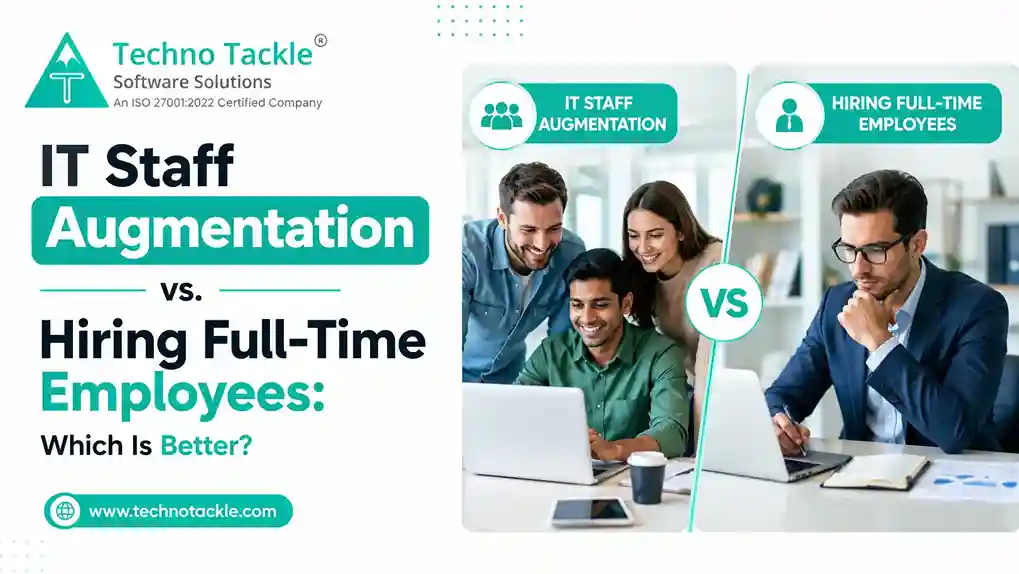
Staff augmentation vs outsourcing comparison for startups showing team control, flexibility, and cost differences in 2026

April 25, 2026

Staff Augmentation vs Outsourcing for Startups: 2026 Comparison Guide

The US tech talent gap is no longer a future problem , it is a current constraint. In 2024 alone, hundreds of thousands of tech roles remained unfilled. For startups, this creates a forced decision point.

You either slow down. Or you extend your team outside the US.

That is where the staff augmentation vs outsourcing debate begins. And despite what many vendors claim, this choice has real consequences for speed, cost, and long-term control.

This 2026 guide breaks it down without fluff , so you can make the right call for your startup's current stage.


What Is Staff Augmentation vs Outsourcing? (The Real Difference)

These two models are often used as if they mean the same thing. They do not.

Software development staff augmentation means external developers join your team. They work inside your systems, follow your processes, attend your standups, and report to you. Functionally, they behave like in-house engineers , minus the hiring overhead.

Outsourcing means handing off responsibility. You define what needs to be built. The vendor decides how to build it. You receive deliverables, not daily visibility.

The difference is control. With staff augmentation, execution stays with you. With outsourcing, execution moves outside your company. That distinction becomes critical as your product evolves.


Staff Augmentation vs Outsourcing: 2026 Side-by-Side Comparison

Use this table to quickly evaluate which model fits your current situation:


Factor

Staff Augmentation

Outsourcing

Winner

Control over work         

Full , you manage daily tasks      

Low , vendor manages execution    

Staff Augmentation

Knowledge retention

High , stays in your team

Low , leaves with vendor

Staff Augmentation

Speed to iterate

Fast , devs inside your sprint

Slow , needs re-scoping

Staff Augmentation

Cost (vs US hiring)

30–50% lower

20–40% lower (variable)

Staff Augmentation

Best for

Core product, ongoing work

Fixed-scope, non-core tasks

Depends on need

Onboarding required

Yes , treat like in-house

Minimal , vendor manages

Outsourcing (short-term)

Culture & ownership

High , joins standups, planning

Low , deliverable only

Staff Augmentation

Risk of IP leakage

Low , integrated into systems

Moderate , external teams

Staff Augmentation

Ideal startup stage

Seed through Series B+

Series A+ for isolated tasks

Depends on stage


When Staff Augmentation Wins for Core Product Development

If you are building your main product, offshore staff augmentation for startups is usually the safer bet. Here is why.

Knowledge Stays Inside Your Company

Augmented developers learn your domain, your users, and your technical trade-offs. That context compounds over time. When someone leaves, your team does not lose the logic behind past decisions.

Iteration Is Faster

Product direction changes weekly in early-stage startups. With software development staff augmentation, developers adapt immediately because they are already part of the conversation. Outsourcing requires re-scoping, approvals, and renegotiation.

Culture and Ownership Matter More Than Founders Expect

Augmented developers join standups, retrospectives, and planning sessions. They understand why things matter, not just what to build. That reduces rework and friction.


When Outsourcing Makes More Sense

Outsourcing can still be the right move, but only under specific conditions. It works best when the scope is stable and clearly defined.

Examples where outsourcing makes sense:

• Data migration projects with defined inputs and outputs

• Infrastructure setup (cloud provisioning, CI/CD pipelines)

• A standalone mobile app with fixed requirements

• Internal tools that will not evolve significantly

• Compliance-heavy or DevOps-specific one-time migrations

The key requirement is clarity. If the problem is still evolving, managed IT outsourcing will slow you down.


Team as a Service vs Outsourcing: A Related Model to Understand

If you have come across the term 'Team as a Service' (TaaS), it sits close to staff augmentation but with a nuanced difference.

With TaaS, you engage a pre-assembled team , typically a product manager, developers, and a QA , as a packaged unit. Like staff augmentation, you retain control over direction. Unlike traditional outsourcing, the team operates as an extension of your company rather than as a separate delivery unit.

How does Team as a Service compare to outsourcing?

• TaaS: Pre-built team, integrated into your workflow, you set priorities

• Outsourcing: Vendor-assembled team, independent execution, you get deliverables

• TaaS: Better for ongoing product development where team composition matters

• Outsourcing: Better for time-bound, fixed-scope projects

For most US startups, TaaS and staff augmentation are more similar than different. Both keep control on your side. Outsourcing does not.


Hidden Costs That Change the Staff Augmentation vs Outsourcing Calculation

Most founders compare hourly rates. That is a mistake. The real costs show up elsewhere.

The Coordination Cost

Outsourcing demands heavy upfront documentation , specs, wireframes, acceptance criteria, and constant review cycles. Someone on your side must manage this full-time. With offshore staff augmentation, developers live inside your existing workflows. Less translation, less overhead.

The Quality Risk

Outsourced work often looks fine until it hits production. Edge cases surface late. Architectural mismatches appear after delivery. Fixes cost more because context is missing. With software development staff augmentation, quality control happens continuously through code reviews and feedback loops.

The Knowledge Transfer Problem

When startups eventually bring work in-house, outsourced systems are painful to absorb. New engineers must reverse-engineer decisions they were never part of. With staff augmentation, knowledge transfer is ongoing , your internal team already understands the system because they helped build it.


The Startup Scaling Phases Where This Decision Matters Most

Seed to Series A

This phase is about speed and learning. You are validating demand and refining your product. Staff augmentation usually wins here. You need senior talent without long-term hiring commitments. Offshore staff augmentation provides that leverage at a fraction of US hiring costs, without sacrificing control.

Series A to Series B

Core product work still benefits from software development staff augmentation. Outsourcing becomes viable for clearly scoped side projects like integrations or internal tools. Many successful startups use a hybrid model at this stage.

Series B and Beyond

Larger companies build stronger in-house teams. Offshore staff augmentation remains useful for rapid scaling, experimentation, or new product initiatives. Outsourcing shifts toward audits, performance tuning, and specialized compliance work.


How to Execute Offshore Staff Augmentation for Startups Without Regret

Start Small

Begin with one developer. Run a three-month pilot. Assign real work , not test tasks. Evaluate skills, communication, and ownership before scaling.

Onboard Seriously

Treat augmented developers like permanent hires. Poor onboarding is the fastest way to fail with offshore staff augmentation. Provide clear documentation, pair programming, and assigned mentors. The first two weeks set the tone.

Design Communication Intentionally

Time zones require structure. Define overlap hours and use them for decisions and collaboration. Document outcomes clearly so work continues smoothly async.

Hold the Same Standards

Measure augmented developers exactly like your internal team. Same expectations, same accountability. That is how you get real ownership.


FAQ: Staff Augmentation vs Outsourcing

1. What is the main difference between staff augmentation and outsourcing?

Staff augmentation adds external developers directly to your team under your management. Outsourcing delegates a project to a vendor who manages their own team and delivers results. The core difference is control , staff augmentation keeps it with you, outsourcing hands it over.

2. Is staff augmentation better than outsourcing for startups?

For core product development, yes. Staff augmentation gives startups control, faster iteration, and knowledge retention. Outsourcing is better suited for fixed-scope, non-core work where the requirements are locked in from day one.

3. How does offshore staff augmentation compare to providers like Turing or Tata Consultancy?

Platforms like Turing and Tata Consultancy offer large talent pools with varying integration models. The key question is: who manages the developer day-to-day? With TechnoTackle, our developers integrate directly into your team and report to you , you manage priorities, we handle hiring, payroll, and compliance. This is true top IT staff augmentation companies, not managed outsourcing.

4. What is staff augmentation in offshore outsourcing?

Offshore staff augmentation is a specific model where you hire developers based outside your country to work as extensions of your internal team. Unlike offshore outsourcing , where you hand off project ownership , offshore staff augmentation keeps project control with you while accessing global talent at lower cost.

5. What is 'Team as a Service' and how is it different from outsourcing?

Team as a Service (TaaS) is a model where a pre-built team (developers, PM, QA) integrates into your company as an ongoing extension. Unlike outsourcing, where a vendor delivers a finished product, TaaS teams work inside your workflow and adapt to your priorities. It is closer to staff augmentation than traditional outsourcing.

6. When should a startup choose outsourcing over staff augmentation?

Choose outsourcing when: (1) the scope is fully defined before work begins, (2) the project is non-core to your product, (3) you do not need the IP or institutional knowledge long-term, and (4) you have someone internally who can review deliverables without being embedded in daily execution.

Share On :

Don't Miss to Claim Your Free Consultation!

We love hearing from our clients and developing their ideas into digital reality. Our team is here to answer all of your questions and provide you with a wide range of IT services that enable you to develop your company.

I am a company

Looking for service

Looking for a Job?

Apply Here
INDUSTRIES