October 27, 2026
Quick answer: Website landing page optimization is the work of improving one page so more of the right visitors take one clear action, such as booking a call. For Indian B2B SMEs, that means one page per offer, a short form, visible proof, a reply within an hour, and tracking by qualified leads instead of raw enquiries.
Most Indian B2B SMEs do not have a traffic problem. They have a conversion problem.
You pay for ads. You publish blogs. You get visitors. Then most of them leave without a word.
This guide shows how to fix that. It covers what to build, what to cut, and how Techno Tackle helps B2B teams turn clicks into sales conversations.
Key Takeaways
-
Send each ad and search visitor to a page built for that one need. Do not send everyone to the homepage.
-
A landing page in SEO should target one specific, high-intent search, not a broad topic.
-
Keep forms short, but ask one or two questions that filter out bad fits.
-
Trust signals above the fold (client logos, ISO certificates, reviews) remove doubt fast.
-
Most leads are won or lost in the first hour after the enquiry arrives.
-
Measure cost per qualified lead and closed orders. Do not measure form fills alone.
Your Website Gets Traffic but Not Qualified Leads
Here is a pattern we see often. A company runs Google Ads, posts on LinkedIn and ranks for a few blog keywords. Traffic goes up. Enquiries do not.
Or enquiries do come, but they are students, job seekers and price shoppers. The real buyers never fill the form.
Four problems cause most of this.
Your Homepage Is Doing Too Many Jobs
A homepage tries to serve everyone. It talks about your story, your team, every service and every industry.
A buyer who searched “mobile app development company for logistics” lands on it and has to hunt for proof that you can help. Most will not hunt. They go back to Google and click the next result.
Your Form Asks the Wrong Questions
Some forms ask for ten fields. Buyers leave.
Other forms ask only for a name and email. Anyone can fill them, so you get junk.
Neither is a good setup. The form should be short, but it should also help you decide who is worth a call.
Nobody Owns the Enquiry
Many SMEs send every form filled to a shared inbox like hello@technotackle.com. When everyone can see it, everyone assumes someone else replied.
The enquiry sits for a day. By then the buyer has already spoken to two of your competitors.
You Count Leads, Not Qualified Leads
A cheap enquiry that never buys is not cheap. It costs you ad spend and sales time.
If your report only shows cost per lead, you cannot tell a good channel from a bad one.
What Weak Landing Pages Cost You
These problems look small. Together they are expensive.
You Pay Twice for the Same Click
You pay Google or LinkedIn for the visit. Then you pay again in sales hours to sort through poor enquiries.
Here is an illustration. The numbers are invented to show the pattern, not to predict your results.
Say an IT services SME gets 100 enquiries in a month. After calls, 15 are a real fit, 25 are “not yet” and 60 are students, freelancers or out of scope. The sales team spent most of the month talking to the 60.
The fix is not more traffic. The fix is a page that attracts and filters better.
Your Best Keywords Bring Your Worst Leads
Broad keywords bring broad audiences. If your page speaks to everyone, it converts almost no one.
Meanwhile, a competitor with a focused page for “[service] for [industry]” shows up as the obvious choice. Your buyer never sees you as an option.
Your SEO Work Does Not Pay Back
You may be investing in content and rankings. If the page that ranks has no clear next step, the traffic is wasted.
Good rankings with a weak page is like a shop on a busy street with a locked door.
A Practical Website Landing Page Optimization Framework
Website landing page optimization is not a design makeover. It is a set of choices that make a page easier to find, easier to trust and easier to act on.
Below is the framework we use at Techno Tackle. It works for staff augmentation firms, software companies, manufacturers and service businesses.
What Is a Landing Page in SEO?
A landing page in SEO is a page built to rank for one specific search and to convert the visitor who arrives from it. It has one topic, one audience and one main action.
It is different from a blog post, which teaches. It is also different from a homepage, which introduces your whole company.
Landing Page for SEO vs Homepage: What Is the Difference?
Use the points below to decide what goes where.
Goal. A homepage introduces the whole company. A landing page for SEO has one job, which is to convert one type of buyer.
Search target. A homepage targets your brand name and broad terms. A landing page for SEO targets one high-intent keyword.
Content. A homepage covers many services and has many links. A landing page for SEO focuses on one offer and has few distractions.
Call to action. A homepage often has several calls to action, and they are often unclear. A landing page for SEO has one main action and one backup.
Form. A homepage usually has a generic contact form. A landing page for SEO uses a short form tied to the offer.
Best traffic source. A homepage gets most of its traffic from direct and brand searches. A landing page for SEO works best with traffic from Google Ads, SEO and LinkedIn.
Measured by. A homepage is measured by visits. A landing page for SEO is measured by qualified leads and orders.
The takeaway is simple. If a buyer comes from a specific search, send them to a specific page.
Step 1: Match One Page to One Buyer Search
This is the base of website landing page optimization. If the page does not match the search, nothing else matters.
Choose Commercial Keywords First
Pick keywords that show buying intent. These usually include words like company, services, provider, pricing, cost, vendor or “for [industry]”.
A landing page for SEO should not chase the biggest volume. A keyword with 200 searches from real buyers is worth more than 20,000 searches from browsers.
Examples of Intent Patterns
-
“[service] company in India”
-
“[service] for [industry]”
-
“hire [skill] developers”
-
“[service] cost” and “[service] pricing”
Build a Page for Each Offer or Industry
Do not squeeze five services onto one page. Build a page for each core service. Then add pages for your best industries.
Each page should speak in the words your buyer uses.
Step 2: Fix the Top of the Page
Visitors decide in seconds whether to stay. The top of the page, before any scrolling, has to answer three questions.
-
What do you offer?
-
Is it for me?
-
What should I do next?
Write a Specific Headline
Weak: “Welcome to our company.”
Better: “Dedicated Laravel developers for US and UK teams, ready in 2 working days.”
State the offer, the audience and the benefit in plain words.
Add Trust Signals Above the Fold
B2B buyers are careful. They need proof before they share their details.
Show client logos, certifications, review ratings and one short testimonial near the top. Do not hide them in the footer.
Trust Signals That Work for B2B
-
Client logos from known brands
-
ISO certificates, such as ISO 27001 for data security
-
Google or Clutch ratings
-
Short testimonials with name, role and company
-
Clear limits, such as minimum project size or engagement models
Step 3: Make the Form Short and Smart
Every extra field lowers the number of people who finish the form. In B2B, a little friction can improve quality. The goal is balance.
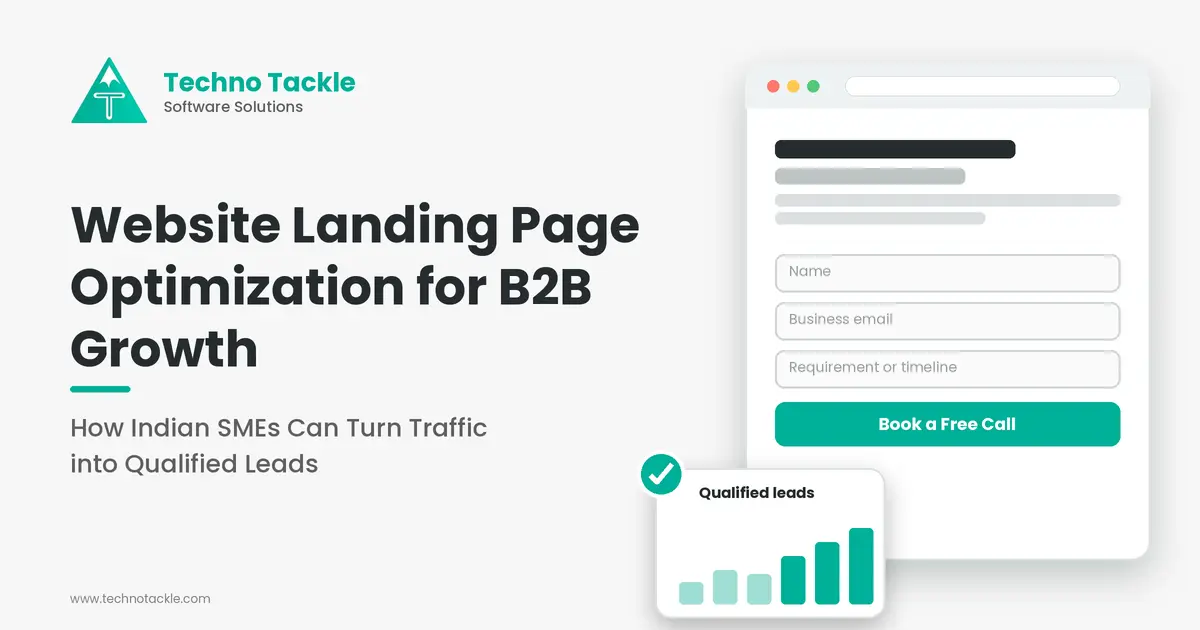
Use three to five fields:
The last two fields do the filtering. A student will not know their timeline. A real buyer will.
Also add a WhatsApp or call option. Many Indian buyers prefer a quick message over a form.
Step 4: Offer Different Calls to Action for Different Buyers
Not every visitor is ready to book a meeting. Give two or three choices.
If the visitor is just researching, offer a download, such as your company profile or a checklist.
If the visitor is comparing vendors, offer a free quote.
If the visitor is ready to talk, offer a 15-minute call.
Keep one action as the main button. The others should look lighter.
Step 5: Make the Page Fast and Mobile-Friendly
A slow page loses visitors before they read a word. Many B2B buyers browse on their phones first and share the link with a colleague later.
Compress images. Remove heavy scripts. Test the form on a mobile screen. Make the buttons easy to tap.
Speed also helps your landing page in SEO, because Google measures how pages perform for real users.
Step 6: Set Up the Page So Google Can Understand and Quote It
This step is where website landing page optimization meets search. Your landing page for SEO should be clear to people and to search engines, including AI tools that pull answers into search results.
Do the On-Page Basics
-
Put the main keyword in the title tag, the H1 and the first 100 words.
-
Write a meta description that promises a clear benefit.
-
Use a clean URL, such as /staff-augmentation-for-fintech.
-
Add alt text to images.
-
Link to related pages on your site.
Write Answers That Google Can Lift
Google often shows a short answer at the top of the results. AI Overviews do the same and cite pages that answer clearly.
To earn that spot, open each section with a one or two sentence answer. Then add detail below it. Use short lists, numbered steps and simple tables. Define key terms in plain words.
This is why this article starts with a quick answer and uses tables. The format is built to be quoted.
Add FAQ and Schema Markup
Add a short FAQ to the page. Mark it up with FAQ and Organization schema so search engines can read it easily. Keep each answer under 60 words where possible.
Add a Short Video
Google often shows YouTube videos for how-to and “what is” searches. A two- to three-minute video on the page can win a second spot in the results.
Keep it simple:
-
Put the main keyword in the video title and first line of the description.
-
Add chapters with timestamps.
-
Upload a transcript or captions.
-
Embed the video on the landing page near the top.
-
Add video schema so Google can link the two.
Step 7: Reply Fast and Qualify Early
Marketing delivers the enquiry. Sales wins or loses it.
Set a response target, such as 30 to 60 minutes during working hours. Assign every enquiry to a named person. Ask four questions on the first call:
-
What problem do you need to solve?
-
What is the scope or team size?
-
Who else is involved in the decision?
-
When do you want to start?
Then sort each lead into one of three groups. Qualified, not yet, or not a fit. Record the reason.
Step 8: Measure What Matters
Track the path from click to revenue, even in a simple sheet.
If you run Google Ads, record offline sales back into your account where possible. This helps the platform bring more buyers like the ones who actually paid.
Be realistic about tracking. No setup catches every touchpoint. Use the data to make better decisions, not to claim perfect credit.
How Techno Tackle Solves This for B2B Teams
You can do all of the above in house. Many SMEs do not have the time or the mix of skills. Here is where Techno Tackle fits.
We Build Pages Made to Convert
Our website development team builds fast, SEO-ready pages that turn visitors into enquiries. Each page has one offer, short forms and proof in the right places.
Your team also needs to edit pages without waiting on a developer. One client, Akshayam Corporate Advisors, shared that they could update most of their website on their own after we built it.
We Make Sure the Right Page Ranks
Our SEO services start with buyer intent. We choose keywords that bring decision makers, build pages around them and fix the technical issues that hold rankings back.
We treat every landing page in SEO as a sales asset, not a traffic project.
We Send the Right Clicks to the Right Page
Paid traffic only works when the page matches the ad. Our Google Ads services pair tight keyword lists and negative keywords with a focused landing page, so you pay for buyers instead of browsers.
We Cut Response Time With Automation
A slow reply is the quickest way to lose a good lead. Our AI automation services can send instant acknowledgements, route each enquiry to an owner, log it in your CRM and remind your team to follow up.
You keep the human conversation. The system handles the busywork.
Why B2B Teams Trust Techno Tackle
Claims are easy. Here is what you can check.
-
11+ years in business. We have worked with 300+ clients on 500+ projects across 10+ countries.
-
ISO 27001:2022 certified. Your data and your leads are handled with documented security processes.
-
Rated 4.8 out of 5 on Google and Clutch. The reviews are public.
-
Long client relationships. Our work with International Training, a US-based scuba training group, has run for more than five years. Their CTO said we understand the system better than most of their internal staff.
-
Speed and reliability. For Biz2Credit in New York, we shared 250+ profiles and placed 30+ people in three months.
We keep promises directional. We do not guarantee a fixed number of leads, because no honest agency can. What we do promise is a clear process, clean reporting and a team that answers fast.
Landing Page Checklist for Indian B2B SMEs
Use this list before you spend more on ads or SEO.
-
One page per offer or industry
-
Target keyword in the title, H1 and first 100 words
-
Specific headline with offer, audience and benefit
-
Client logos, certificates and one testimonial above the fold
-
Form with three to five fields, including one qualifying question
-
WhatsApp or call option beside the form
-
One main call to action and one backup
-
Page loads fast and works on mobile
-
Short FAQ with schema markup
-
Short video embedded near the top
-
Every enquiry assigned to a named person
-
Response target of 30 to 60 minutes
-
Privacy notice that explains how you use enquiry data
-
Monthly review of lead sources by qualified leads
A note on privacy. India’s Digital Personal Data Protection Rules, 2025, put more focus on clear notices when you collect personal data. Check your obligations with a legal adviser.
Frequently Asked Questions
What is website landing page optimisation?
Website landing page optimization is the process of improving a page so more visitors take a specific action, such as requesting a quote or booking a call. It covers the message, the form, the proof, the speed and the follow-up.
What is the difference between a landing page in SEO and a homepage?
A landing page in SEO targets one search and one buyer type. A homepage introduces the whole company. Landing pages convert better for specific searches because the page matches what the buyer wants.
How many form fields should a B2B landing page have?
Three to five is a good range. Ask for name, business email and company. Add one or two questions, such as requirement or timeline, to filter out poor fits.
How long does it take to see results from website landing page optimisation?
Paid traffic can show changes within weeks. SEO usually takes longer, often a few months, depending on competition and your site’s strength. Set targets from a small test, then adjust.
Should I use a landing page for SEO or for ads?
Use both, but build them for their own purpose. A landing page for SEO is written to rank and to convert organic visitors. An ad landing page can be tighter and carry fewer links. Many teams start with one strong page and adapt it.
What should I measure on a B2B landing page?
Track enquiries, the percentage that are qualified, meetings booked, orders won and cost per qualified lead. Raw form fills hide the real picture.
Next Step: Turn Your Traffic Into Qualified Leads
If your traffic is not turning into sales conversations, the page is usually the problem, not the traffic.
Pick your most important service. Build one focused page for it. Add proof, shorten the form and reply fast. Then measure qualified leads for 60 days.
If you want a second pair of eyes, Techno Tackle can review your page and show you what to fix first.
Ready to turn visitors into qualified leads?
Book a free 15-minute consultation. We will look at your current page, your traffic and your lead flow, then give you a clear plan.
Book your free consultation on Calendly