Business Tips to Overcome Legacy System Mindsets

April 3, 2024

Tips to Overcome Legacy System Mindsets

Two major factors in the IT industry are always at odds with one another: growth and cost-cutting. While cutting costs is still important for every business, for companies that focus on digital, focusing only on it might be a fatal mistake. This is particularly true for legacy systems with outdated infrastructure and software that limit creativity and responsiveness.

At Techno Tackle Software Solutions, we are aware of the difficulties that both new and experienced businesses undergo in adjusting to the ever-changing technological landscape. As consultants in managed teams and staff augmentation for offshore development, we have hands-on knowledge of how holding onto outdated methods could slow down a company's expansion.

This blog talks about three ways of thinking that prevent businesses from accepting digital transformation and keep them tied to outdated technologies.


1. Investment vs. Capital Expense

A lot of businesses consider updating their IT infrastructure to be expensive. This kind of thinking ignores the long-term advantages that new systems provide. Legacy systems frequently experience:

  • Limited Scalability: They need costly updates or solutions as a result of being unable to adjust to expanding data volumes and user needs.
  • Security Risks: Computer hacking on outdated systems can result in data breaches and errors in operations, making them ideal targets.
  • Problems with Integration: It might be difficult to integrate with contemporary platforms and apps, which can lead to the isolation of data and reduce productivity.

Alternatively, modern systems are designed with integration, security, and scalability in mind. Even though the initial investment may be greater, these systems result in considerable long-term cost reductions by:

  • Enhanced Productivity: Automated processes and streamlined workflows free up personnel and cut down on manual work.
  • Lower Maintenance Costs: Modern systems are easier to integrate with emerging technology and require less maintenance.
  • Enhanced Security: Up-to-date security features and frequent updates reduce security risks, protecting the company from possible financial and social damage.
  • Changing Your Point of View: Consider digital transformation as an investment rather than a cost. Long-term, this investment will result in significant savings in costs and open up new business potential. Take into account these extra variables:

A. Return on Investment (ROI): As you assess new systems, figure out how much money you could make. This can involve things like better customer happiness, decreased downtime, and enhanced production.

B. Total Cost of Ownership (TCO): Don't limit your thinking to a new system's initial cost. When comparing options, be sure to account for ongoing maintenance, license fees, and training costs.

You may make an argument for the long-term advantages of upgrading your IT infrastructure using a complete approach.


2. Resource Availability

Many companies think they don't have the internal resources necessary to carry out a major IT shift. This anxiety is a result of the false belief that switching to new systems takes a lot of time and an experienced IT staff.

But the reality is quite different:

  • Cloud-Based Programs: Many modern technologies are cloud-based, which allows for faster implementation and requires less on-premises equipment. Additionally, automatic maintenance and upgrades are provided via cloud solutions, which reduces the demand on your resources.
  • Managed Services: Businesses can hire experienced software developers for migration initiatives by working with offshore development partners like us. Your internal staff can now concentrate on key company operations as a result. We can provide knowledge in fields such as:

A. System Integration: To ensure smooth data flow and business continuity, our staff can expertly integrate your new and current systems.

B. Data Migration: With the least amount of downtime and changes possible, we can manage the safe transfer of your data to the new platform.

  • Training and Support: Throughout the migration process, our team can train your staff on the new system and provide continuous support.
  • Phased Implementation: Replacing a large number of systems at once might be confusing. The process can be much more easily handled by taking a step-by-step approach and addressing one module at a time. This reduces potential risks by enabling you to test and adjust as you go.
  • Changing Your Attitude: Accept the knowledge of offshore development teams. By collaborating with them, you may get the knowledgeable employees you require to manage complicated migrations without disturbing your main business operations. Seek a partner who can provide you with adjustable engagement models so you can expand or reduce your staff as necessary.


3. Fear of Change:

Organizations that have used outdated systems for a long time may find change to be scary. On the other hand, holding onto outdated technology over time may have significantly greater negative effects. This is the reason why:

Lack of growth in innovation: The functionality needed to deploy fresh ideas and business models is frequently absent from legacy systems. They may make it harder for you to stay in touch with companies that are more flexible and adjust to shifting market demands.

Competitiveness: Organizations that continue to use outdated technologies find it difficult to keep up with competitors that have accepted digital transformation. These competitors can gain a major competitive advantage by reducing expenses, improving consumer experiences, and utilizing modern technologies.

Talent Acquisition: Working with modern technologies is a priority for young people and younger generations of talent. These groups may find your company disappointing due to outdated systems, which will make it more difficult for you to draw in and keep top employees. This may have an ongoing impact on productivity, creativity, and general business expansion.


Our Case Study: Responding to Change for Development

You only need to look at these success stories to understand how accepting change may help firms advance:

Leading manufacturer of clothing worldwide, LKN switched from an outdated ERP system to a cutting-edge, cloud-based platform. This resulted in a 15% increase in yearly income by increasing their operational efficiency by 20%, increasing data visibility by 75%, and improving real-time decision-making.

WordPress is a well-known platform, started life as a simple blogging tool. Through the implementation of new technology and trends, it has developed into a top website construction tool that millions of people use all over the world. Over 43% of all websites on the internet are now powered by WordPress, demonstrating the value of constant adaptability.

Laravel is an open-source framework for web applications that distinguishes itself by focusing on developer experience and innovation. It provides a clear and expressive vocabulary that helps the development of complex web applications by developers. Because of this, organizations like Pfizer, the BBC, and Slack have started to use Laravel, underscoring the significance of staying on top of trends.

Changing Your Point of View: Understand the risks of failure to act. Accept change as a chance to realize the full potential of your company. Here are some more ideas to help you get over your fear of change:

Start Small: Don't attempt to completely redesign your IT system in a single day. Start by selecting a particular area in which your progress is being slowed by legacy systems. Before expanding, try a new system in this field to gain confidence and experience.

Effective Communication: Throughout the process of transformation, keep your employees informed. Address their worries and outline the advantages of upgrading. Having a clear path of communication can reduce opposition and increase support.

Put Training First: Make sure your employees receive thorough training on the new system. By doing this, they can make the most of its benefits and reduce any downtime while the switch is being performed.


Path for Working together for Digital Transformation

Any digitally focused company that wants to achieve sustainable growth must move away from outdated procedures. Gaining a competitive edge and opening up new chances can be achieved by accepting a growth mindset and realizing the limitations of outdated technologies.

We at Techno Tackle Software Solutions are here to assist you in navigating the process of going digital. We provide a number of services to help with your migration, such as:

Technology consulting: our qualified staff may assess your existing IT setup and provide the most effective upgrading solution.

System Implementation and Selection: We can assist you in selecting the best systems for your requirements and manage the complete implementation procedure.

Ongoing Support: To make sure your new systems are operating efficiently, and your staff is at ease utilizing them, we provide continuing assistance.

You can take advantage of highly trained professionals and affordable solutions by working with a safe offshore development company to meet your objectives for digital transformation. You may free your company from the constraints of outdated systems and direct it in the direction of expansion and innovation with the right approach and set of minds.

Read more
Business Business leaders analyzing global locations for an offshore development center, focusing on talent availability, cost efficiency, and strategic outsourcing decisions.

March 26, 2024

How to Choose the Right Location for Your Offshore Development Center

Choosing the right location for your offshore development center (ODC) is one of the most consequential decisions a CTO or CEO will make in their software development journey. Get it right, and you gain access to elite engineering talent, reduce costs by 40–70%, and scale your product faster. Get it wrong, and you face communication breakdowns, quality issues, and costly rebuilds.

The global offshore software development market is projected to reach nearly $198 billion in 2026, with more than 70% of enterprises now relying on remote or offshore teams for software engineering , driven not just by cost savings but by the need for specialized tech skills and faster time-to-market. With this kind of momentum, the question is no longer whether to establish an offshore development center, but where. 

This guide is designed specifically for mid-stage companies, CEOs, and CTOs who want to make a smart, strategic location decision for their offshore development center.

staff augmentation


What Is an Offshore Development Center and Why Location Matters

An offshore development center (ODC) is a dedicated software development team located in another country that works exclusively for your company. These teams function as an extension of your internal engineering department and are responsible for building, testing, maintaining, and scaling software products. 

Unlike traditional project outsourcing, an ODC gives you full control over your team, your codebase, and your intellectual property. The location you choose directly affects your cost structure, talent quality, time zone overlap, communication quality, and legal compliance. Every one of these factors must align with your business goals before you sign a contract.


Key Factors to Evaluate When Choosing an ODC Location

Before comparing countries, you need a decision framework. Businesses should consider factors such as the availability of skilled talent, cost of living, infrastructure, political stability, time zone differences, and ease of doing business when selecting a country for their offshore development center. 

Here is how to weigh each factor:

1. Talent Pool and Technical Depth

The depth of available engineering talent is your first filter. Look beyond raw developer numbers , assess specialization in your tech stack. India produces over 2.5 million STEM graduates annually, the second-highest output globally, with 34% of all graduates in STEM fields. This makes India the top choice for companies that need scale quickly. However, if you need niche expertise in fintech security or embedded systems, Eastern Europe may offer better-matched talent. 

2. Cost Savings

Cost is often the initial driver, but it should not be the only one. An offshore development center in India can reduce development costs by 40 to 60 percent compared to hiring in the US or UK. A mid-sized ODC of 20 engineers may cost $35,000 to $50,000 per month, covering salaries, office space, payroll, and benefits. For context, offshore software development rates vary significantly by region , Asia runs $20–$50/hour, Latin America $25–$55/hour, and Eastern Europe $30–$58/hour. 

3. Time Zone Compatibility

Time zone alignment directly impacts daily standups, sprint reviews, and incident response. Enterprises operating in Europe often prefer Eastern Europe or MENA for regulatory alignment, while US-based companies may choose Latin America for real-time collaboration. However, India continues to be the most attractive offshore location for businesses looking for the ideal mix of cost-effectiveness, skill depth, and scalability. For UK-based companies especially, India's partial time zone overlap (typically 4–5 hours of shared working hours) makes daily collaboration very manageable. 

4. English Proficiency and Communication

Poor communication is the silent killer of offshore projects. Vietnam offers 500,000+ software professionals with 70% English proficiency , a combination that creates a sweet spot many companies have been seeking: quality, communication, and cost-effectiveness. India similarly offers strong English proficiency at scale, which is why it remains the first choice for most UK and US companies building managed offshore teams. 

5. Geopolitical Stability and Legal Framework

Your ODC location must be stable enough to protect your intellectual property and ensure business continuity. In 2026, most reputable vendors follow strict cybersecurity standards and sign NDAs , always ask for evidence of compliance with standards such as ISO/IEC 27001 and review their incident history. Countries with mature legal frameworks around IP protection and data privacy (GDPR alignment for UK companies) significantly reduce your risk. 

6. Cultural Compatibility

Cultural alignment affects how well your offshore team integrates with your internal team. The Philippines has high English communication levels and strong cultural fit with Western businesses, making it an emerging destination for offshore development. India and Eastern European countries also score well for Western business culture alignment. 


Top Offshore Development Center Locations in 2026

India , Best for Scale, Cost Efficiency, and Managed Teams

India remains at the top of the list for offshore development centers, with an immense engineering workforce and powerful IT infrastructure. It is the dominant choice for UK and US mid-stage companies that need to build a full managed offshore development team quickly without compromising quality. 

Cities like Jaipur, Coimbatore, Ahmedabad, and Vizag are emerging as strong ODC destinations, offering 25–30% cost advantages over Tier-1 cities while providing access to growing talent pools with lower attrition. If your company prioritizes specific domains: Bangalore is best for AI/ML, Pune for DevOps, Hyderabad for full-stack, and Chennai for SaaS products. 

Eastern Europe (Poland, Ukraine, Romania) , Best for Quality and EU Alignment

Eastern Europe is strong for EU-based clients needing time zone proximity, with Poland and Ukraine particularly well-regarded for fintech, security, and sophisticated software engineering. The talent quality rivals domestic hiring in Western Europe, making this a preferred choice for companies where code quality and senior engineering skill are the primary priorities over cost. 

Latin America , Best for US Companies Needing Real-Time Collaboration

Latin America has surged in popularity thanks to convenient time zones and cultural familiarity with US companies , it is a favorite for leaders who want a dedicated offshore development center with real-time communication. Countries like Mexico, Argentina, and Brazil are increasingly capable technology hubs for product development at competitive rates. 

Vietnam and Southeast Asia , Best for APAC-Focused Companies

Vietnam leads for APAC-based clients and those prioritizing AI capability, compliance, and cost efficiency. The country's government investment in digital infrastructure and education has created a rapidly growing talent pool well-suited for modern software development. 


ODC Location Checklist for CEOs and CTOs

Before finalising your location decision, use this checklist:

  • Do they have proven talent in your specific tech stack?

  • What are the all-in monthly costs (salary, infrastructure, HR, compliance)?

  • How many hours of daily time zone overlap does your internal team have?

  • What is the English proficiency level of senior developers?

  • Is the country geopolitically stable with strong IP protection laws?

  • Does your ODC partner offer GDPR or ISO 27001 compliance?

  • What is the average developer attrition rate at this location/partner?

  • Can the team scale from 5 to 20+ developers without quality drop?

If you are also thinking about how to maintain control over your codebase once your ODC is in place, read our guide on [how to maintain codebase control with offshore development teams] , it covers Git practices, CI/CD pipelines, code review workflows, and security measures that protect your intellectual property.


The Offshore Development Model That Fits Your Location Choice

The most popular ODC model involves a dedicated software development team of tech experts based in a remote location, working solely for your company , with the best part being that you can increase or decrease team size depending on the needs of your projects. 

Beyond the dedicated model, there are two others worth considering based on your location and maturity:

  • Build-Operate-Transfer (BOT): Your ODC partner sets up and runs the center, then transfers full ownership to you. Common in India for companies planning long-term presence.

  • Hybrid Model: Your internal team handles product strategy and stakeholder communication while the offshore team manages engineering execution , a structure that enables businesses to maintain strategic control while enjoying global development capacity. 

At Techno Tackle, we specialise in helping companies design the right offshore model for their goals , whether that is a fully managed offshore development team, staff augmentation, or a hybrid approach. We go beyond delivering code; we build lasting partnerships with offshore teams that scale with your business.

managed offshore teams


Common Mistakes to Avoid When Choosing an ODC Location

Many companies choose a location based on cost alone and discover too late that other factors matter more. Here are the pitfalls to watch for:

Offshore engagements most often fail not from lack of talent but from weak operational clarity once the work begins , making visibility and ownership the deciding factors between a vendor and a real partner. 

Some vendors present senior talent during the sales process but replace them once the engagement begins. Always insist on contractual clarity around key team members and require approval rights for major staffing changes.

Additionally, do not underestimate the hidden costs of high attrition. A partner who invests in developer retention will cost less in the long run than one who offers a lower daily rate but rebuilds the team every eight months.


Why Techno Tackle Is Your Offshore Development Partner

Techno Tackle specialises in managed offshore development teams, staff augmentation, and dedicated development centres. We understand that choosing an offshore location is just the beginning , the real value comes from building a team that integrates deeply with your business, maintains your codebase standards, and delivers consistently at scale.

Whether you are exploring offshore development for the first time or looking to restructure an existing partnership, our team will guide you through every decision , location, model, legal setup, and day-to-day operations.

Ready to choose the right offshore development center location for your business? 

offshore development to discuss your specific goals and find the offshore model that works for you.

Read more
Business How To Choose The Right Engagement Model For Software Development

March 14, 2024

How To Choose The Right Engagement Model For Software Development

Guidelines To Select Right Engagement Model

If you are a business owner, it is possible that you have attempted software development and  implementation for your business. If you have attempted software development and implementation for your business,it is quite possible that you have failed in the same. Yes, most software implementation projects fail - That's the harsh reality, even if you don't like it. 


So, this blog is intended to explain why this happens and how you can do a better job of choosing the right engagement model for developing and deploying software for your business. 


Why do most attempts fail?

Firstly, let’s understand the skill sets of an average businessperson. They  intuitively understand anything related to their product, service, people, consumer requirements, sales, etc. But, when it comes to pure technical domains like accounting or software development and implementation, they don’t have the functional knowledge to understand what is relevant and what fits their needs. 


But entrepreneurs, being entrepreneurs, value progress more than anything else.  So they take a decision and move forward, only to realize after that they have hit a dead end, the project is done and dusted, and they have lost quite a few things - firstly, their hard earned money; secondly - their valuable time; and finally - their team’s hope of implementing any software. At this stage , they have developed a fixed mindset that anything related to software development is not going to work for them. 


Factors For Success

For successful software development and implementation, there are several factors to be considered

  • Choosing the right vendor

  • Having your requirements objectively captured, agreed upon by the user and communicated to the vendors before proceeding to the development stage

  • Making sure that you have the right model of engagement with your vendors


In the upcoming section of this blog, we are going to explain the various models in which you can engage with your software vendors, establish a few parameters that will help you choose the right vendors depending on the context.


Available Engagement Models


There are four models of engagement with your software vendor. They are


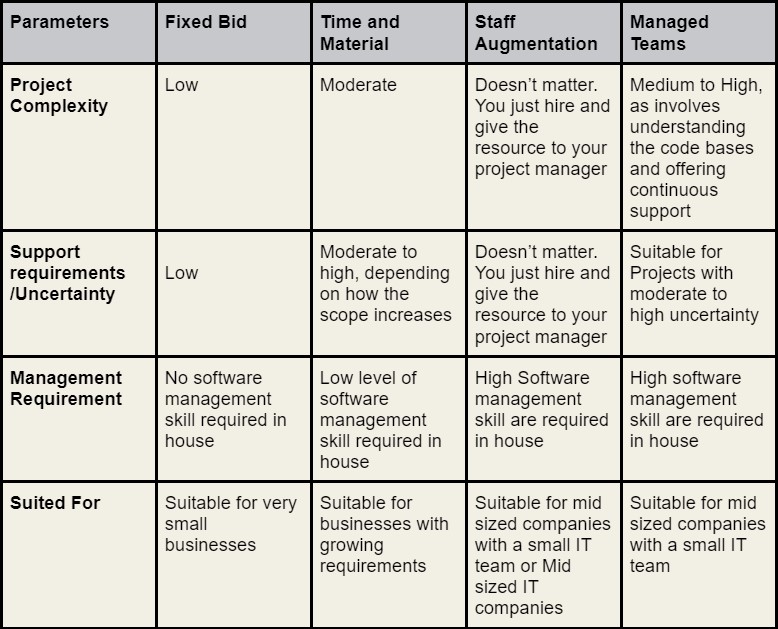
  1. Fixed Bid

It is the simplest of all. You freeze the scope, ask for a quote, and freeze the quote for the scope - That’s it. If your scope is small, absolutely well defined, and if the complexity of the project is relatively low, it can be a good model to choose. Here, the degree of uncertainty should be low. The advantage is that you can get your development done at a low cost. But, if you have not done a thorough job at the scope stage or if you keep increasing the scope during the development phase, two things happen - One your relationship with the vendor gets strained and two - you will be developing something that is not of high quality or something that is difficult to implement


  1. Time and Material

It is the exact opposite of a fixed bid.  Here, you don’t pay for the output; rather, you pay for the time for which the resources have been used. Here, the per hour cost of all resources involved in the project is agreed upon, and each bill is closed based on a timesheet containing the number of hours each resource has worked in that cycle. It is advisable to go for a time and material model if the scope is not set in stone  - In most circumstances, the scope might be broad and open in nature. Under such scenarios, it is better to opt for time and material so that the output quality is not affected due to the time constraint. If you have the budget, if you want great quality, and if you have an open scope, it might be a good model to go for. But, the disadvantage is that you should have some way of evaluating what might be a reasonable time for delivering the requirements. In other words, you should have the tech know how to evaluate if the output is commensurate with the time spent, or you should have a vendor who is transparent and reliable 


  1. Staff Augmentation

This is not for you if you don’t have a tech team inside. This is suitable for entrepreneurs who have an in house tech team and want specialized capabilities for a specific period of time. Of course,you can hire a freelancer for the same.  But, an individual might not have the accountability that an entity does.  So it is preferred to hire a resource on a short term contract from a vendor offering staff augmentation services - Go for it only for urgent, specialized, and short term requirements. The advantage is that - you keep the costs variable; once the need for the resources is over, you need not pay for them. The disadvantage is that the per month cost can be on the higher side. However, if it is going to solve your problem, it is worth it.  Also, it can be a great way to scale or downsize your resources depending on market conditions. 


  1. Managed Teams

The managed team is almost the same as staff augmentation , except that here the management aspect of the project is also outsourced. Assume you have a tech start up and have a small internal team to develop and deploy stuff. As your needs grow, you might want to introduce new modules, or you might want a solid maintenance team for your product or project. In those cases, this could be a great model, as you have a vendor who takes accountability for the resources and their management. If you can identify a great vendor who can understand your code base in detail and provide solid support—nothing like that—it makes a lot of sense to go for the model, as you will get quality and flexibility


Parameters For Selecting Engagement Model


Conclusion

Knowing your requirement parameters and choosing the right model of engagement with your software vendor can increase the probability of success significantly. So,the next time you think of developing something for your business needs, write down your requirements and choose the model that works for them. Cheers!!!

Read more
Business Smart Hiring for Tech Companies: Save Rs. 54,000/year on Every Fresher Trainer

March 12, 2024

Smart Hiring for Tech Companies: Save Rs. 54,000/year on Every Fresher Trainer

National Apprenticeship Training Scheme (NATS)

Modern technology alone won't help you stay ahead in the fast-paced field of information technology; experienced staff  are also necessary. How can you improve the lives of young people in India and boost the bottom line of your business simultaneously? The National Apprenticeship Training Scheme (NATS), a game-changing program, provides the key to the solution.


What is NATS?

The Indian government's innovative National Apprenticeship Training Scheme (NATS) aims to skill the educated youth of the nation. It's an intelligent attempt to maximize the potential of India's youth population, more than a plan.


Benefits for Employees Working in IT:

1. Reimbursement Rewards

The government of India offers compensation benefits to IT companies up to Rs. 4500 per month for each candidate, for a total of Rs. 54,000 in financial awards annually. This benefits the cash flow of your business in addition to producing skilled employees.


2. Compliance Benefit

Employees can take a one-year break from contributing to PF and ESI, which helps them and reduces financial stress. This makes the work environment more supportive and friendly.


3. Streamlined Recruitment Process

NATS makes it easier for IT companies to hire new employees by improving the general training and recruitment process. Notifications are sent via email and appear live on the NATS site, which makes it easy to find and develop new talents.


4. Enhanced Reputation

Being a part of NATS might help your business become known as a socially responsible one. Making a good contribution to society is more important than just doing business.


5. Addressing Skill Scarcity

NATS-trained trainees provide a skilled employee suitable for the particular requirements of the IT industry. It's a good approach for avoiding gaps in skills and training your employees for the future.


6. Embracing Opportunity

You don't need interns after training, but it can boost your business. Using NATS to spot and train people is a smart way to keep growing over time.


How to Participate and Who Can Apply for NATS?

1. Available to Every IT Company

NATS is available to anyone, no matter the size—a start-up or well-established IT company. Your organization's size or structure is not a barrier to eligibility; rather, it also depends on how dedicated you are to skill development.


2. A Wide Range of Skills

Technically skilled people of various backgrounds, including diploma graduates, engineering graduates, and other non-engineering graduates, are welcome at NATS. For new talent looking to enter the IT industry, there is a flexible opportunity with an extended window of five years post-qualification.


3. Apprenticeship Stipend

The government of India offers your candidates an apprenticeship that is highly desirable to both employers and apprentices, with a stipend of Rs 4500 per month.


4. Valuable Certification

With its important position in job markets, the NATS certificate of performance gives your interns real credentials to help launch their IT careers.


5. Career and Business Opportunities

Beyond employment opportunities, NATS-trained interns have a good possibility of landing a permanent position with your business. They might also look at candidates for self-employment, which would encourage business in the digital industry.


6. Improved Registration Process

Go to https://nats.education.gov.in/index.php to sign up for NATS. For simple setup and student registration, read the manuals. The "Contact Us" area of the portal has all the information you need to ask questions.


Conclusion:

The National Apprenticeship Training Scheme (NATS) is transforming the tech industry by focusing on skill enhancement, cost efficiency, and long-term talent development. It promises immediate financial benefits and a more robust workforce for the future. NATS' selection as IT leader signifies a commitment to India's youth's future and a strategic business move, highlighting the potential of educated youth to boost the economy. IT companies are considering joining NATS to educate skills, reduce unemployment, and collaborate with other IT founders to have a long-term impact on the country's youth.

Read more
Quality 0

March 2, 2024

SonarQube Code Quality Checker Tool For Software Development

How to develop high coded software using the SonarQube tool?

Have you ever been stuck with messy code that's hard to understand and fix? Not only you, however, but this issue may have affected every IT CTO and CEO. In this blog, we will discuss a tool that helps to fix all the developers' issues and improves code quality. We are going to talk about a helpful tool called SonarQube.

What is SonarQube?

SonarQube is an open-source platform that discovers bugs, security flaws, and code smells in over 20 programming languages in addition to executing continuous code quality inspection and automatic reviews.

What are the benefits of SonarQube for high-quality code?

• Improves Quality: Enhances application code quality, leading to increased revenue, brand awareness, and better user engagement.

• Grows Developer Skills: Provides regular code feedback, enabling developers to learn from mistakes and improve future code.

• Continuous Quality Management: Incorporates quality control in every development phase, increasing maintainability and reducing technical debt costs.

• Reduces Risk: Scans code as it's written, reducing digital risk and preventing security breaches.

• Scalable: It will handle projects with millions of lines of code.

• Increases Productivity: Reduces maintenance costs, allowing developers to focus on code writing.


How SonarQube improve code quality for software?

If you are a developer, team leader, or project manager, picture yourself as a CTO/CEO managing a project that is full of errors, duplication of code, and security holes. The code appears to be a very challenging puzzle to solve, a common headache for all developers trying to improve code quality in complex scenarios. This situation often leads to frustration, especially when the deadlines for the project are tight.

Trying to fix these issues becomes a priority for the software development team, which creates a lot of stress for the team. In situations like these, maintaining good code quality feels like a difficult task. but there is a solution - SonarQube. This tool helps guide the developers through the code challenges, find the real problems, and improve the overall code quality of the software product.


Boosting Code Quality with SonarQube at Techno Tackle Software Solutions:

When managing code becomes a very difficult task for the developers, frustration increases, particularly when they meet tight deadlines. Enhancing the code quality becomes a tough job, and bugs that appear at the deployment stage require more time and effort to fix rather than moving forward.

In our company Techno Tackle Software Solutions we have 80+ employees including developers, who fight with this issue during our software development life cycle. Recognizing the need for solutions, we implemented SonarQube. This tool acts as a signal, making a difference as we explore through the complexities of code, identify issues, and ultimately enhance the quality of our software development processes, providing great relief to the developers.

We knew poor code quality was slowing down our teams for several reasons:

  • Reduced productivity of developers: Expended time troubleshooting flawed old code

  • An excessive number of production flaws pushes inadequate, untested code

  • Performance at slow speeds: Growing technical debt over time

  • High upkeep expenses: sustaining complex codebases can be challenging

After weighing our options, we chose to use SonarQube as the standard for integrated code quality and technical debt management.


How to improve code quality using SonarQube?

SonarQube is a code quality assurance tool that performs in-depth code analysis and generates an analysis report to ensure code reliability. SonarQube combines static and dynamic code analysis to empower continuous code quality practices.

SonarQube also provides support for 27 different languages, including C, C++, Java, Javascript, PHP, GO, Python, and much more. SonarQube also provides CI/CD integration, and gives feedback during code review with branch analysis and pull request decoration.

SonarQube is a robust code quality analysis tool with a combination of both static and dynamic analysis tools to review the source code and generate reports on the code quality of your project. It identifies bugs in your code by scanning the project and notifying developers to address them. To implement SonarQube, you need to install the tool, subsequently install a scanner, and create projects for scanning.


The achievements and future goals of integrating SonarQube:

As a result of our collective dedication to writing cleaner code, our engineering culture has improved. In the last six months, we've seen:

  • 35 percent fewer errors and bugs

  • A 55% decrease in production-related complaints

  • Average developer velocity increased by 47%.

  • Much easier on boarding for new employees

We want to use SonarQube even more in the future to continue our study and meet our high standards for quality. As the future limits of quality, integrating security and performance testing are high on our list of priorities!


Conclusion:

Is the speed of your codebase decreasing? Do performance difficulties, safety risks, and bugs come into production? Is the time spent debugging complicated, outdated systems?

Don't accept what is present if your team can connect to these difficulties, or else constructed deadlines will keep degrading quality. When you examine SonarQube objectively, you'll see how much more productive development can be achieved.

Ask for a free, customized consultation. Please contact our team to get started on the transformation right now. Allow us to identify your particular problems and provide code quality data to demonstrate how SonarQube may assist in effectively solving them. Request a free SonarQube consultation to enhance code performance.

Read more
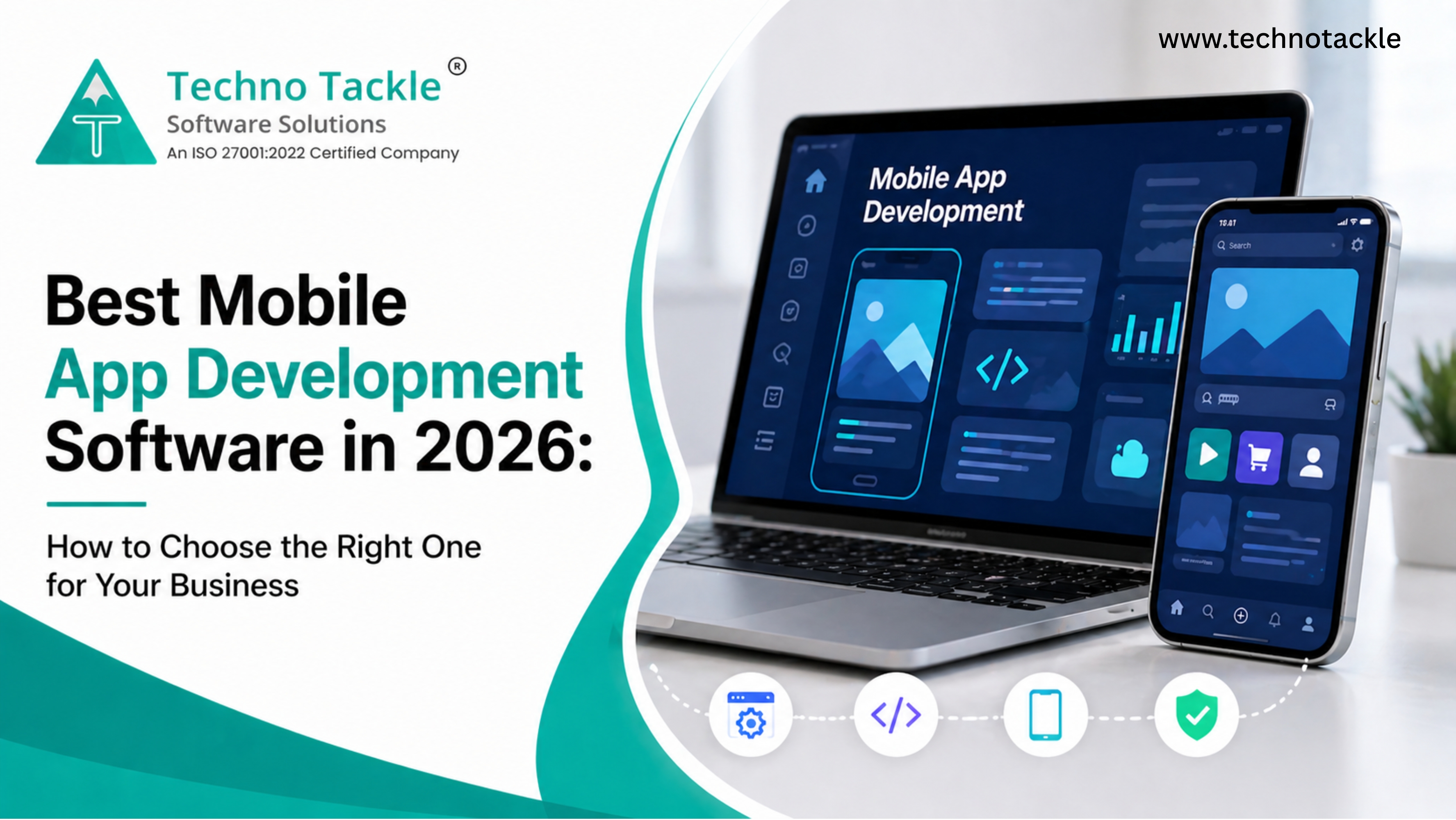
Mobile Apps Laptop and smartphone displaying mobile app development interface and UI design elements

February 28, 2024

Best Mobile App Development Software in 2026: How to Choose the Right One for Your Business

Choosing the best mobile app development software in 2026 is one of the most important technical decisions your business will make. The wrong choice costs you months of rework and thousands in wasted budget. The right one gets your app to market faster, scales with your business, and keeps your development team productive.

The US mobile app market alone is projected to hit $200 billion in 2026, with mobile app downloads expected to exceed 300 billion globally. Whether you are a startup building your first product or an enterprise upgrading legacy systems, the software and framework you choose directly shapes your launch timeline, user experience, and long-term maintenance costs. 

This guide compares the top mobile app development software options for 2026 , covering cross-platform frameworks, native tools, and emerging low-code platforms , with practical guidance on which is right for your specific business situation. 


Why Choosing the Right Mobile App Development Software Matters

The mobile app development landscape has changed significantly since 2024. Gartner projects that by 2026, low-code development tools will account for 75% of new application development, and more than 80% of enterprises will have deployed AI-enabled applications. Alongside this, cross-platform frameworks have matured to the point where businesses no longer need to choose between development speed and app quality. 

Teams consistently report 30–40% faster development cycles and 50–80% effort reduction compared to building separate native applications. This makes your framework choice not just a technical decision , it is a business strategy decision. 

The right mobile app development software should provide a user-friendly developer experience, support cross-platform deployment, integrate security best practices natively, and scale with your product roadmap. If you are working with an offshore development team or managed mobile app developers, the choice of software also affects how easily your team can collaborate, maintain code quality, and onboard new developers.

mobile app development services


Types of Mobile App Development Software in 2026

Before comparing specific tools, it helps to understand the four main categories:

Native Development uses platform-specific languages , Swift for iOS and Kotlin for Android. This gives maximum performance and full access to device features but requires maintaining two separate codebases.

Cross-Platform Frameworks like Flutter and React Native let you write one codebase that runs on both iOS and Android. Industry estimates show cross-platform development continues to grow because it reduces development timelines by 30–40% compared to traditional native app development. 

Hybrid Frameworks like Ionic use web technologies (HTML, CSS, JavaScript) to build mobile apps, making them easiest to adopt for web developers but with some performance trade-offs.

Low-Code / No-Code Platforms like FlutterFlow and AppSheet allow non-developers to build functional apps, and are growing rapidly for MVPs and internal business tools.


Top Mobile App Development Software in 2026

1. Flutter , Best for Cross-Platform Performance and Pixel-Perfect UI

Flutter commands approximately 46% market share among mobile developers in 2026, making it the dominant force in cross-platform mobile development. Developed by Google using the Dart programming language, Flutter compiles to native ARM code , delivering performance that rivals native apps. 

Flutter's rendering engine draws every pixel, ensuring pixel-perfect consistency on every screen, with widgets that render smoothly at 120Hz. The Hot Reload feature allows developers to see code changes instantly without restarting the app, significantly speeding up iteration cycles. 

Best for: Startups and agencies shipping MVPs quickly, businesses that need consistent UI across iOS and Android, and teams that value design precision.

Key features: Single codebase for iOS, Android, web and desktop; extensive widget library; strong Google backing; free and open source.

2. React Native , Best for Teams with JavaScript/Web Experience

React Native remains the most widely adopted cross-platform framework globally. React Native is used by Microsoft in Office, Skype, and Xbox Game Pass, and by Meta in Facebook and Messenger , a testament to its production-grade reliability at scale. 

React Native is the right choice for startup MVPs where you need fast shipping, easy adjustment, and affordable development for small teams. If your engineering team already knows JavaScript and React, the transition to React Native is very low friction. 

Best for: Web development teams moving into mobile, businesses that need a large pool of available developers, and projects requiring rapid prototyping.

Key features: JavaScript/TypeScript codebase, vast community library ecosystem, Meta-backed with active development, Fast Refresh for real-time coding feedback.

3. Kotlin (and Kotlin Multiplatform) , Best for Android-First and Shared Logic

Kotlin is Google's officially recommended language for Android development in 2026. Beyond standard Android development, Kotlin Multiplatform (KMP) transforms how teams share logic between platforms without sacrificing native performance , unlike React Native or Flutter, KMP doesn't replace native UI; it only shares the logic layer. 

Companies like Netflix, Cash App, and Slack already use KMP to share core business logic while building high-quality native UIs on each platform.

Best for: Android-first applications, enterprise teams modernising legacy apps, and businesses requiring native UI fidelity alongside code reuse.

Key features: Concise syntax, built-in null safety, full Java interoperability, Coroutines for async programming, and growing multiplatform capabilities.

4. Swift (and SwiftUI) , Best for iOS-Exclusive Applications

For businesses building exclusively for the Apple ecosystem, Swift remains the gold standard. SwiftUI is a declarative UI framework that allows developers to design interfaces faster across Apple platforms, significantly reducing development time while maintaining consistent UI and responsiveness. 

Swift gives you first-class access to Apple's latest APIs , including ARKit, Core ML, HealthKit, and HomeKit , often on the same day Apple releases them. No cross-platform framework can match this for cutting-edge iOS features.

Best for: iOS-exclusive apps, businesses deeply integrated into the Apple ecosystem (watchOS, tvOS, macOS), and applications requiring advanced iPhone hardware capabilities.

Key features: Apple-backed, high performance, modern syntax, Playgrounds for rapid prototyping, Automatic Reference Counting for memory management.

5. .NET MAUI , Best for Enterprise Teams Using Microsoft Technologies

.NET MAUI (Multi-platform App UI) is Microsoft's evolution of Xamarin, allowing C# developers to build native apps for Android, iOS, Windows, and macOS from a single codebase. For enterprise applications, .NET MAUI is recommended thanks to its long-term stability, strong integration with cloud ecosystems, reliable performance, and mature security support. 

Best for: Microsoft-stack enterprises, teams with strong C# experience, and businesses that need Windows and mobile from a single codebase.

6. Low-Code Platforms (FlutterFlow, AppSheet) , Best for MVPs and Internal Tools

With low-code platforms now production-ready rather than experimental, non-technical founders can build production applications in weeks, allowing faster validation of app ideas. FlutterFlow generates real, exportable Flutter code , meaning you can hand off to a development team for further customisation, unlike most no-code tools. 

Best for: Founders validating ideas quickly, businesses building internal operational tools, and non-technical teams building prototypes before investing in full development.


Mobile App Development Framework Comparison: Choosing the Right Technology for Your Project

Selecting the right mobile app development framework is one of the most important decisions in any app development project. The ideal framework depends on your target platforms, performance requirements, development timeline, and the skills of your development team. Whether you're building an MVP, a large-scale enterprise application, or a platform-specific mobile app, understanding the strengths of each framework can help you make an informed choice.

Flutter has become one of the most popular cross-platform frameworks for building visually rich mobile applications. Using the Dart programming language, Flutter enables developers to create high-performance apps for iOS, Android, Web, and Desktop from a single codebase. It is particularly well suited for startups, MVPs, and businesses that require pixel-perfect user interfaces with near-native performance.

React Native is another leading cross-platform framework that uses JavaScript, making it an excellent option for organizations with existing web development teams. It supports both iOS and Android development while offering near-native performance and access to a large global developer community. React Native is a great choice for businesses looking to accelerate development while leveraging JavaScript expertise.

For companies that require maximum performance, Kotlin Multiplatform (KMP) allows developers to share business logic across Android and iOS while still building native user interfaces. It is ideal for organizations that want to maintain native performance while reducing duplicate code. Similarly, Swift and SwiftUI remain the preferred technologies for iOS-exclusive applications, delivering the highest level of performance, seamless Apple ecosystem integration, and access to the latest iOS features.

Organizations invested in the Microsoft ecosystem often choose .NET MAUI, which uses C# to build applications for iOS, Android, and Windows from a unified codebase. It offers near-native performance and integrates well with existing .NET enterprise applications, making it a strong option for business software and internal enterprise solutions.

For startups and businesses that want to build products quickly with minimal coding, FlutterFlow provides a visual development platform powered by Flutter. It enables rapid prototyping, MVP development, and no-code or low-code application creation while still delivering near-native performance for iOS and Android.

Ultimately, there is no single framework that fits every project. Flutter is an excellent choice for cross-platform applications with modern UI requirements, React Native is ideal for JavaScript-based teams, Kotlin Multiplatform and Swift are best for performance-focused native development, .NET MAUI suits Microsoft-centric enterprises, and FlutterFlow is perfect for rapid MVP development. Choosing the right framework based on your business objectives, technical requirements, and long-term scalability will help ensure the success of your mobile application.


How to Choose the Right Mobile App Development Software for Your Business

For a startup MVP, React Native or Expo is the fastest to ship, easy to adjust, and affordable for small teams. For performance-critical software, Flutter or fully native Swift/Kotlin delivers steady frame rates and predictable behaviour under load. For enterprise systems, Kotlin Multiplatform or .NET MAUI offers strong structure, shared logic, and long-term maintainability. staff augmentation 

Beyond the framework itself, ask these questions before making a decision:

What platforms do you need? If you need iOS and Android from day one, cross-platform saves significant time and budget. If you are iOS-only, Swift is the clear choice.

What does your development team know? Choose a technically superior framework that your development team doesn't know well, and you'll ship slower and buggier than if you'd chosen a framework your team loves. Team familiarity often matters more than framework benchmarks. 

What is your timeline and budget? Cross-platform development typically reduces timelines and costs compared to maintaining two native codebases. If speed-to-market is your top priority, Flutter or React Native is usually the answer.

How complex is your app? For apps requiring advanced camera features, AR, or deep hardware integration, native Swift or Kotlin gives you capabilities no cross-platform framework can fully replicate.

If you are building your app with an offshore mobile app development team or using staff augmentation to extend your in-house capabilities, also consider developer availability in your chosen talent market. Flutter and React Native developers are widely available globally, making them easier to hire for and scale.


Mobile App Development Trends to Watch in 2026

The framework you choose today should also position you well for where mobile development is heading:

AI Integration: Gartner research shows 40% of enterprise applications will feature task-specific AI agents by the end of 2026, up from less than 5% in 2025. Choosing a framework with mature AI/ML library support , Flutter and React Native both qualify , future-proofs your investment. 

Low-Code Acceleration: The rise of low-code tools is not replacing professional development; it is shifting where professional developers spend their time , on complex features rather than boilerplate.

Cross-Platform Maturity: In 2026, users decide whether to keep an app in under 5 seconds, and modern frameworks like Flutter and React Native deliver near-native performance and fluid UIs that are indistinguishable from native apps to real users. 

Edge AI and On-Device Processing: Frameworks that support native integration , particularly Swift and Kotlin , are best positioned for apps where privacy and on-device processing are core requirements.


Partner with Experts to Build Your Mobile App

At Techno Tackle, we are recognised as one of the best mobile app developers in India, with extensive experience building iOS and Android apps using Flutter, React Native, Kotlin, and Swift. We work with startups, mid-stage companies, and enterprises to build mobile applications that are scalable, secure, and delivered on time.

Whether you need a dedicated offshore mobile development team, staff augmentation to extend your in-house engineers, or a fully managed mobile app development service, our team brings the technical depth and process discipline to deliver results.

Looking to build your mobile app with the right software and the right team? Contact Techno Tackle today and let's discuss your project requirements.


FAQ Section

What is mobile app development software?

Mobile app development software includes programming languages, frameworks, SDKs, development environments, testing tools, and other technologies used to build mobile applications.

Which software is commonly used for cross-platform mobile app development?

Common cross-platform options include Flutter and React Native, which allow developers to build applications for multiple platforms using shared development technologies.

When should I choose native app development?

Native development can be appropriate when an application requires platform-specific performance, deep operating-system integration, or specialized iOS or Android functionality.

Is Flutter good for startup app development?

Flutter can be useful for startups that want to develop applications for multiple platforms from a shared codebase, although the suitability depends on the product's technical requirements.

Is React Native suitable for business applications?

React Native can be suitable for many business and consumer applications, particularly where teams want to share development code across iOS and Android.

How do I choose the right mobile app development software?

Consider platform requirements, performance, development skills, project complexity, device features, maintenance needs, time to market, and long-term scalability.


Read more

No Blogs Found

We couldn't find any blogs matching your search. Please try a different keyword.

Don't Miss to Claim Your Free Consultation!

We love hearing from our clients and developing their ideas into digital reality. Our team is here to answer all of your questions and provide you with a wide range of IT services that enable you to develop your company.

I am a company

Looking for service

Looking for a Job?

Apply Here
INDUSTRIES